
Senja Travel Guide
Senja is where jagged mountains meet Arctic beaches, fishing villages, wild coastline and long summer light. This guide shows you how to experience the island properly, from hiking, whale watching and scenic drives to northern lights, local food, winter activities, places to stay and the practical details that make travelling around Senja easier.
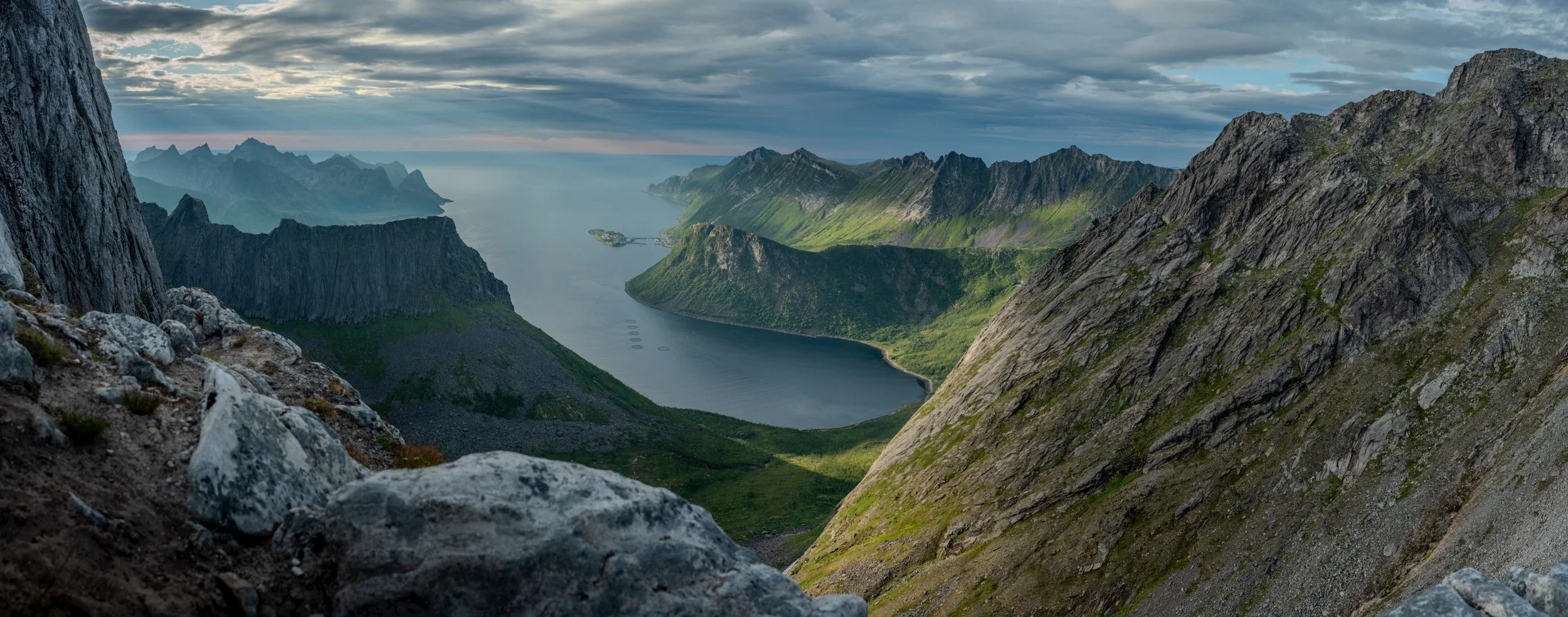
Table of Contents
Introducing Senja
Things to Do on Senja
Go Whale Watching and Look for Arctic Wildlife
Explore Senja from the Sea
Go Hiking
Go Fishing
Explore Ånderdalen National Park
Experience the Midnight Sun
See the Northern Lights
Go Ski Touring
Go Snowshoeing
Discover Senja’s Cultural and Local History
Experience Senja’s Festivals and Local Events
The Norwegian Scenic Route Senja
Where to Eat on Senja
Where to Stay on Senja
When Is the Best Time to Visit Senja?
How to Get to Senja
Getting Around Senja
Combining Senja with Tromsø, Vesterålen and Lofoten
Practical Things to Know Before Visiting Senja
Final Words
Introduction
Senja is Norway’s second-largest mainland island, located in Northern Norway between Tromsø and the Vesterålen archipelago. It is best known for its dramatic outer coastline, where steep mountains rise directly from the sea and narrow fjords cut into the island, but the landscapes change considerably as you travel further inland and south.
Northern and western Senja contain many of the places that have made the island famous: Segla and Hesten above Fjordgård, the jagged Okshornan peaks, white Arctic beaches and small fishing communities squeezed between mountains and the sea. Further inland, the scenery becomes greener and more sheltered, with forests, lakes, wetlands and Ånderdalen National Park. This contrast is one reason Senja is sometimes described as “Norway in miniature”.
The sea is equally important to understanding the island. Fishing has shaped Senja’s settlements and economy for generations, and many of the communities along the coast are still working fishing villages rather than places created primarily for tourism. Sámi history, inland settlements and the changing Arctic seasons add further layers to an island that is often introduced almost entirely through photographs of its mountains.
Senja can therefore be many different kinds of destination. It can form the centre of an active hiking trip, a coastal journey built around wildlife and the sea, a winter stay beneath the northern lights or part of a longer journey through Northern Norway. This guide looks at the experiences, landscapes, communities, food and practicalities that make Senja worth exploring beyond its most famous viewpoints.
If you are still deciding where Senja fits within a wider trip through the region, Northern Norway Travel Guide gives a broader introduction to Northern Norway and its main destinations. If you are specifically deciding between Senja and Lofoten, Senja: The New Lofoten? compares the two in much more detail.
Things to Do on Senja
Senja is often associated first with hiking and dramatic mountain viewpoints, but the island offers considerably more than its most photographed landscapes. Some of its strongest experiences are connected to the surrounding sea and wildlife, while others take you into fishing communities, forests, cultural landscapes and the very different conditions created by the Arctic seasons.
1. Go Whale Watching and Look for Arctic Wildlife
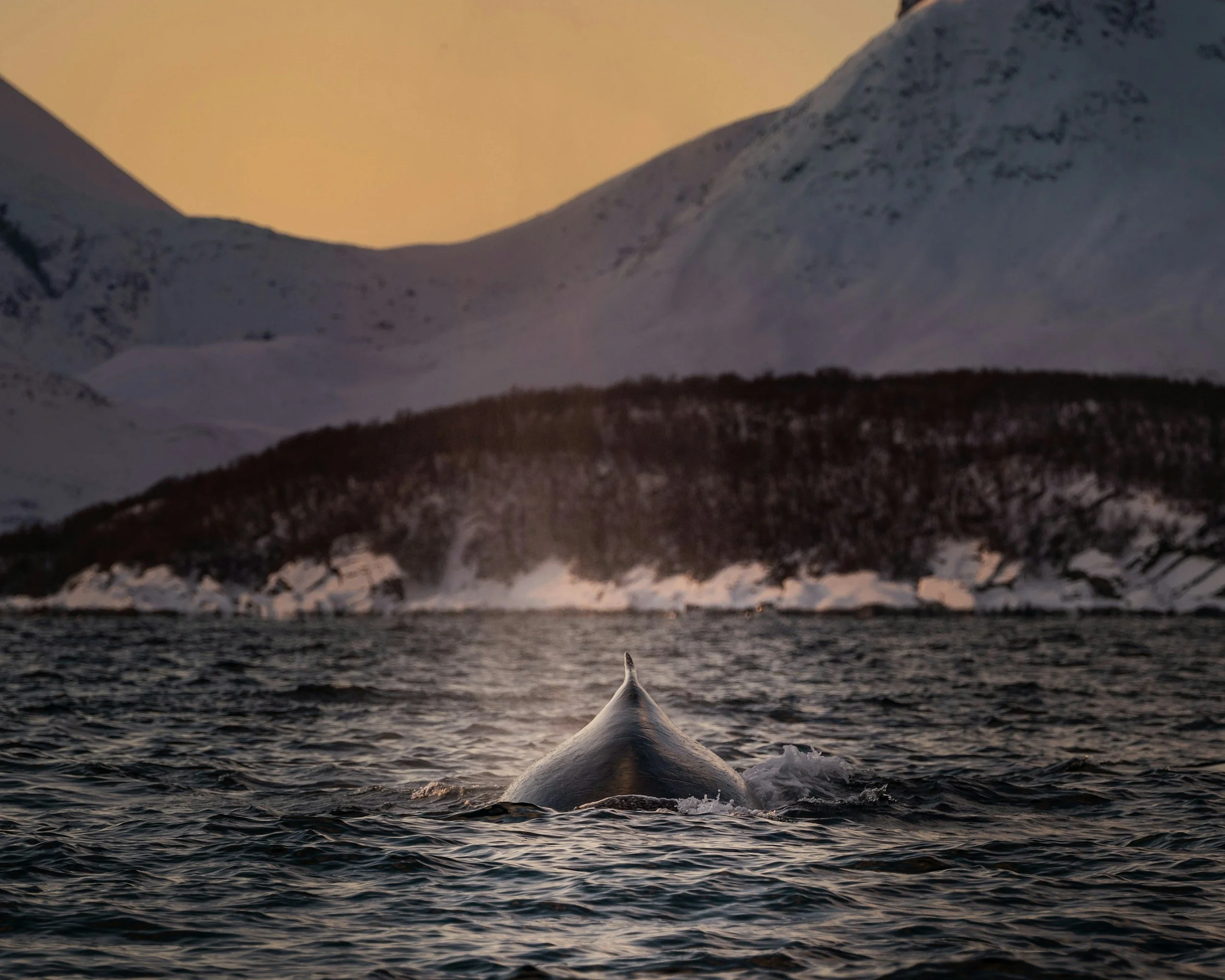
Senja is a good destination for travellers who want wildlife to form part of the trip rather than simply hoping to spot something from the roadside. Dedicated whale safaris operate from the island during the summer season, while broader wildlife excursions focus on the marine environment around Senja and its offshore islands.
Whale-watching trips from western Senja travel towards deeper waters around Senja and neighbouring Andøya, where several whale species can occur. As with whale watching anywhere in Norway, sightings depend on where the animals and their food are at the time. A whale safari should therefore be treated as a wildlife experience rather than a guaranteed encounter with a particular species.
This is also different from the winter whale watching associated with other parts of Northern Norway. Whale distribution changes through the year, so the best place to see whales in Norway depends heavily on the season. Whale Watching in Norway explains where the main whale-watching areas are, when to visit them and which species you may encounter.
Whales are only part of Senja’s wildlife. White-tailed sea eagles are frequently seen along the coast, while seals, porpoises and a variety of seabirds inhabit the fjords and offshore islands. Bergsfjorden and other parts of Senja’s outer coast are particularly interesting if you want an excursion focused on the wider marine ecosystem rather than whales alone.
If whales are your priority, choose a dedicated whale safari rather than assuming a general wildlife or sightseeing trip will offer the same experience. If you are more interested in seeing whatever wildlife is present while also experiencing the coast, a broader wildlife safari is the better choice.
For a wider overview of the animals you can encounter elsewhere in the country, including whales, reindeer, moose, seabirds and other Arctic species, see Wildlife in Norway.
2. Explore Senja from the Sea
Senja’s roads and hiking trails reveal only part of its coastline. Fjords cut deep into the island, while the outer coast breaks into small islands, skerries, beaches and narrow channels that are difficult or impossible to reach by road. Getting onto the water therefore gives you a genuinely different perspective on the island rather than simply another way to see the same places.
Kayaking
Kayaking is the best option if you want to explore the coast slowly and close to the water. Bergsfjorden on western Senja is particularly well suited to this, with an archipelago of small islands, white beaches and sheltered passages beneath the surrounding mountains. Guided trips are available for beginners as well as more experienced paddlers, so previous sea-kayaking experience is not necessarily required.
RIB Excursions
A RIB, or rigid inflatable boat, offers a very different experience. These fast boats can cover much more of the coastline in a few hours and reach exposed stretches of coast and offshore islands that would take considerably longer to explore by kayak. Guided RIB and fjord expeditions operate around areas such as Bergsfjorden, sometimes including landings on small islands when conditions allow.
Boat and Fjord Trips
More traditional boat and fjord trips are the better choice if you want to be on the water without paddling or the speed of a RIB. Some combine sightseeing with coastal history or stops around the archipelago, making them particularly suitable if the landscape itself is the main reason you want to go out to sea.
The three experiences are different enough that the choice is fairly simple: choose kayaking for a quiet and immersive experience, a RIB if you want to cover more of Senja’s coast, and a conventional boat trip if you prefer a slower and more comfortable excursion. Whichever you choose, seeing Senja from sea level changes the scale of the landscape. The mountains become the backdrop, while the fjords and fragmented outer coastline become much easier to understand.
3. Go Hiking
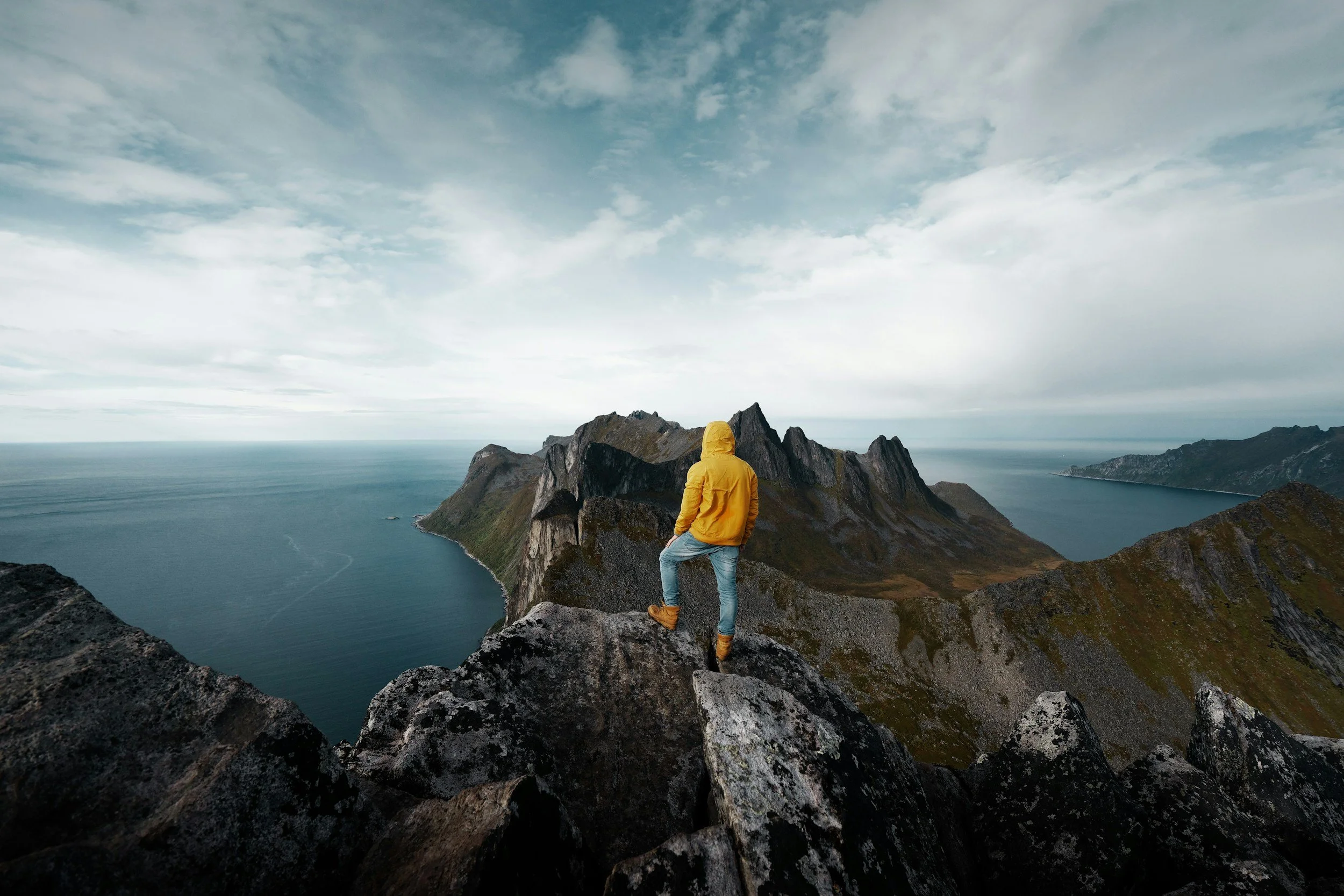
Hiking is one of the main reasons people travel to Senja. The island’s mountains are not particularly high by Norwegian standards, but many rise almost directly from sea level, so relatively short routes can involve substantial elevation gain and enormous views across fjords, islands and the Norwegian Sea. The terrain can also be steep and exposed, which means distance alone is not a good indication of how demanding a hike will be.
Hesten: The Famous View of Segla
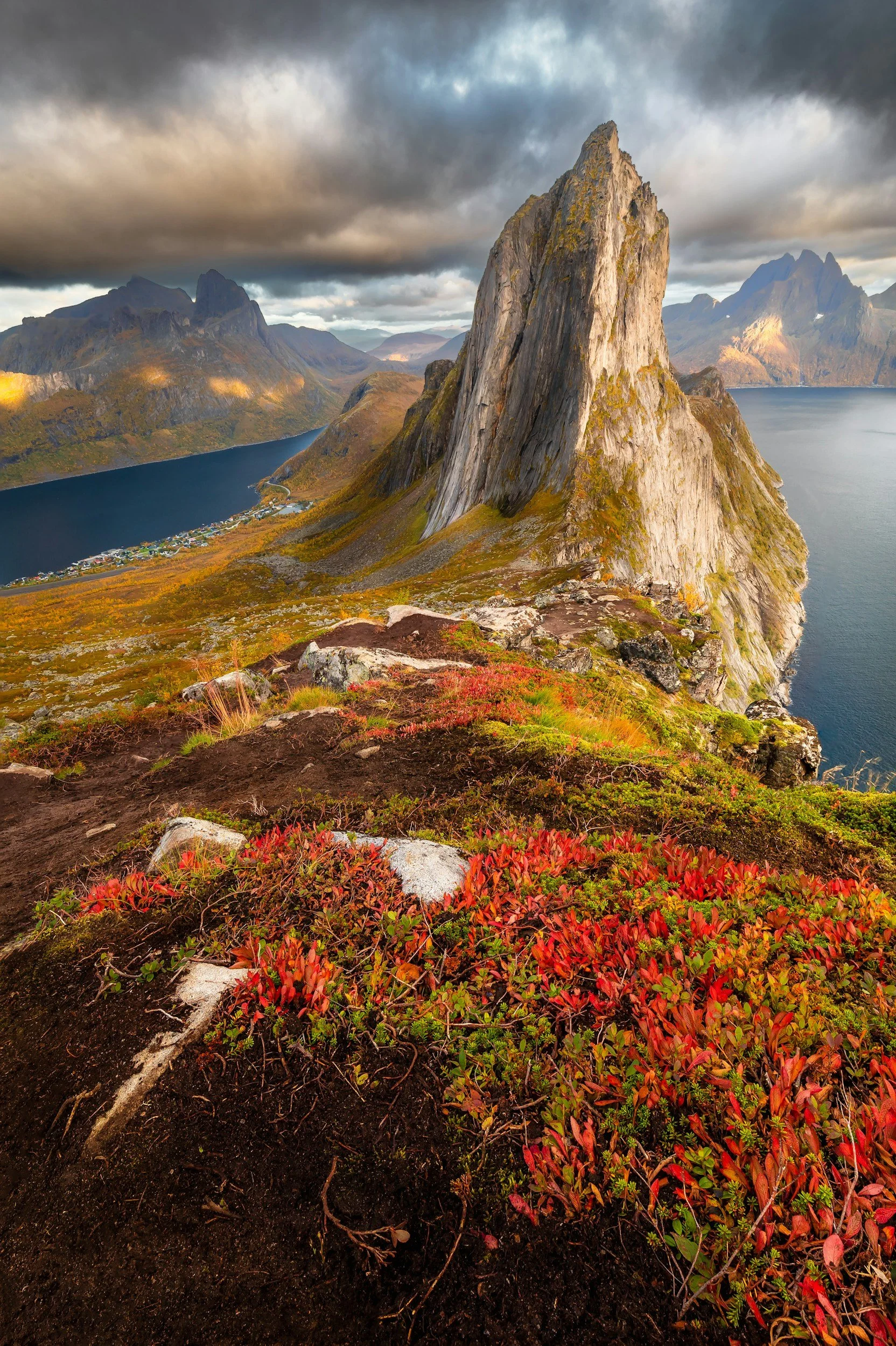
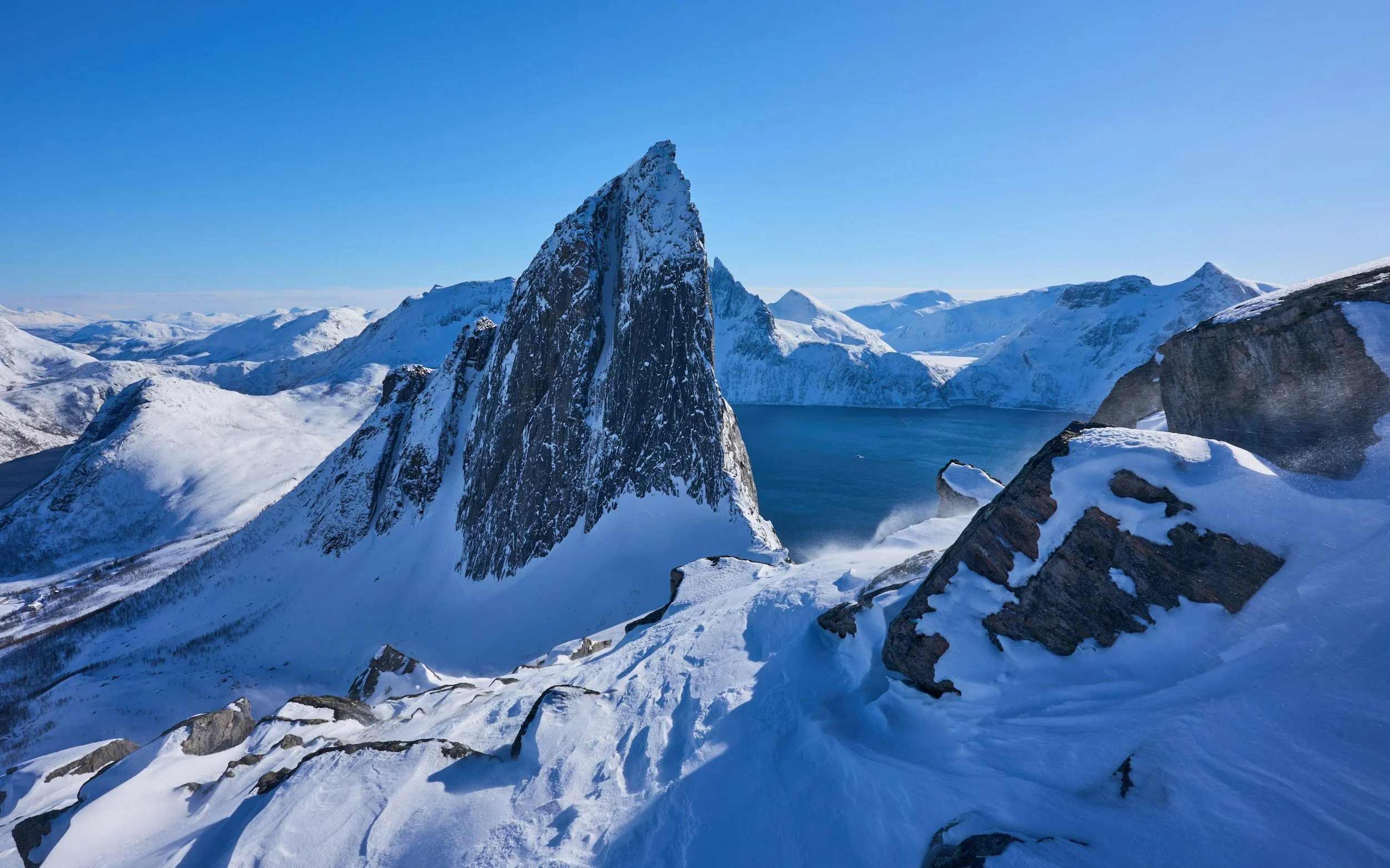
If you have seen photographs of a hiker standing above a fjord with the enormous triangular wall of Segla rising opposite, the photograph was almost certainly taken from Hesten rather than Segla itself.
Hesten rises above Fjordgård on northern Senja and provides the classic side-on view towards Segla, with Mefjorden far below. The famous viewpoint is reached before the highest point of Hesten, so you do not need to continue to the summit if the Segla view is your main reason for doing the hike.
The route is relatively short but climbs steeply, gaining roughly 500 metres from Fjordgård, and wet conditions can make the terrain considerably more difficult. If you are choosing between Hesten and Segla, choose Hesten for the iconic view of Segla and the less exposed mountain experience.
Segla: Climb the Mountain Itself
Segla begins from the same general area around Fjordgård, but it is a very different hike. Rather than looking across at the mountain, you climb onto Segla itself. The upper part of the route becomes steep and exposed, with terrain where a fall could have serious consequences.
The reward is an extraordinary position above Mefjorden and Øyfjorden, but if your main objective is the famous photograph of Segla, Hesten is the better choice. Choose Segla if the summit itself is the objective and you are comfortable hiking in steep and exposed terrain.
Husfjellet: For the Bergsfjorden Panorama
Husfjellet offers a very different view of Senja. Starting near Skaland, the route climbs above Bergsfjorden and opens towards the islands and skerries scattered along the outer coast. Rather than one dominant mountain forming the centre of the view, the attraction is the much broader panorama across western Senja and the Norwegian Sea.
The hike is longer than Hesten and involves more elevation gain, but much of the route is less exposed than the upper section of Segla. If you want to complete two major hikes on Senja, I would pair Hesten and Husfjellet rather than automatically choosing both Hesten and Segla, as the two routes show much more contrasting landscapes.
Other Hikes Worth Considering
Senja has many more hiking routes than the three that appear most frequently in travel guides. Barden above Mefjorden is worth considering if you want a longer mountain hike with extensive fjord views, while more demanding routes such as Keipen provide options for experienced hikers looking for a bigger mountain day.
You also do not need to climb one of Senja’s steep coastal summits to experience the island on foot. Ånderdalen National Park offers walking through forest, wetlands, rivers and lakes, while shorter coastal paths and walks around the Scenic Route stops provide access to dramatic landscapes without requiring a major mountain ascent.
Weather should always influence which route you choose. Low cloud can completely remove the views that make the higher hikes worthwhile, while rain and wind can make exposed terrain considerably more difficult. Norwegian hiking culture places strong emphasis on adjusting plans to the conditions rather than completing a route at all costs. The Norwegian Mountain Code explains the principles used in Norway for planning and travelling safely in the mountains.
Hiking is also closely connected to the wider Norwegian tradition of friluftsliv, where spending time outdoors is part of everyday culture rather than something reserved for major expeditions. Norwegian Outdoor Culture: Friluftsliv, Hiking and Everyday Nature explains that relationship with nature in more depth.
4. Go Fishing
Fishing remains an important part of life on Senja, and joining a fishing trip is one of the most direct ways to experience the waters surrounding the island. Guided sea-fishing excursions operate from several coastal communities, with local skippers taking visitors into the fjords and towards fishing grounds along the outer coast.
Sea Fishing
Cod, saithe and halibut are among the species commonly targeted around Senja, although catches depend on the season, location and conditions. Most guided trips provide the necessary equipment, making sea fishing accessible even if you have little previous experience.
If catching a particular species matters to you, choose the trip accordingly. Halibut fishing, for example, requires different techniques and knowledge of suitable fishing grounds, so a specialist guide is a better choice than a general fishing excursion if halibut is specifically what you hope to catch.
Winter Fishing and Skrei
Winter and early spring bring one of Northern Norway’s most important fishing seasons. Skrei are migratory Atlantic cod that travel from the Barents Sea towards the Norwegian coast to spawn, and their arrival has supported seasonal fisheries in Northern Norway for centuries.
Some operators on Senja offer winter fishing trips during this period, making it possible to experience a very different side of the island from the summer boating season. The combination of winter landscapes and an active fishing season makes this particularly interesting if you want your trip to reflect what is actually happening in the coastal communities at that time of year.
Freshwater and Shore Fishing
Fishing from shore is possible in suitable coastal locations, while Senja’s lakes and rivers also offer freshwater fishing. Regulations vary, however, and freshwater fishing generally requires permission or a fishing permit for the specific water.
Salmon fishing is subject to additional regulations, so always check the rules for the particular river before fishing rather than assuming that general access to nature includes the right to fish anywhere.
For most travellers who simply want to experience fishing on Senja, a guided sea-fishing trip is the most straightforward choice. The equipment and boat are taken care of, while the local skipper provides knowledge of the fishing grounds, conditions and species that would be difficult to replicate independently.
5. Explore Ånderdalen National Park
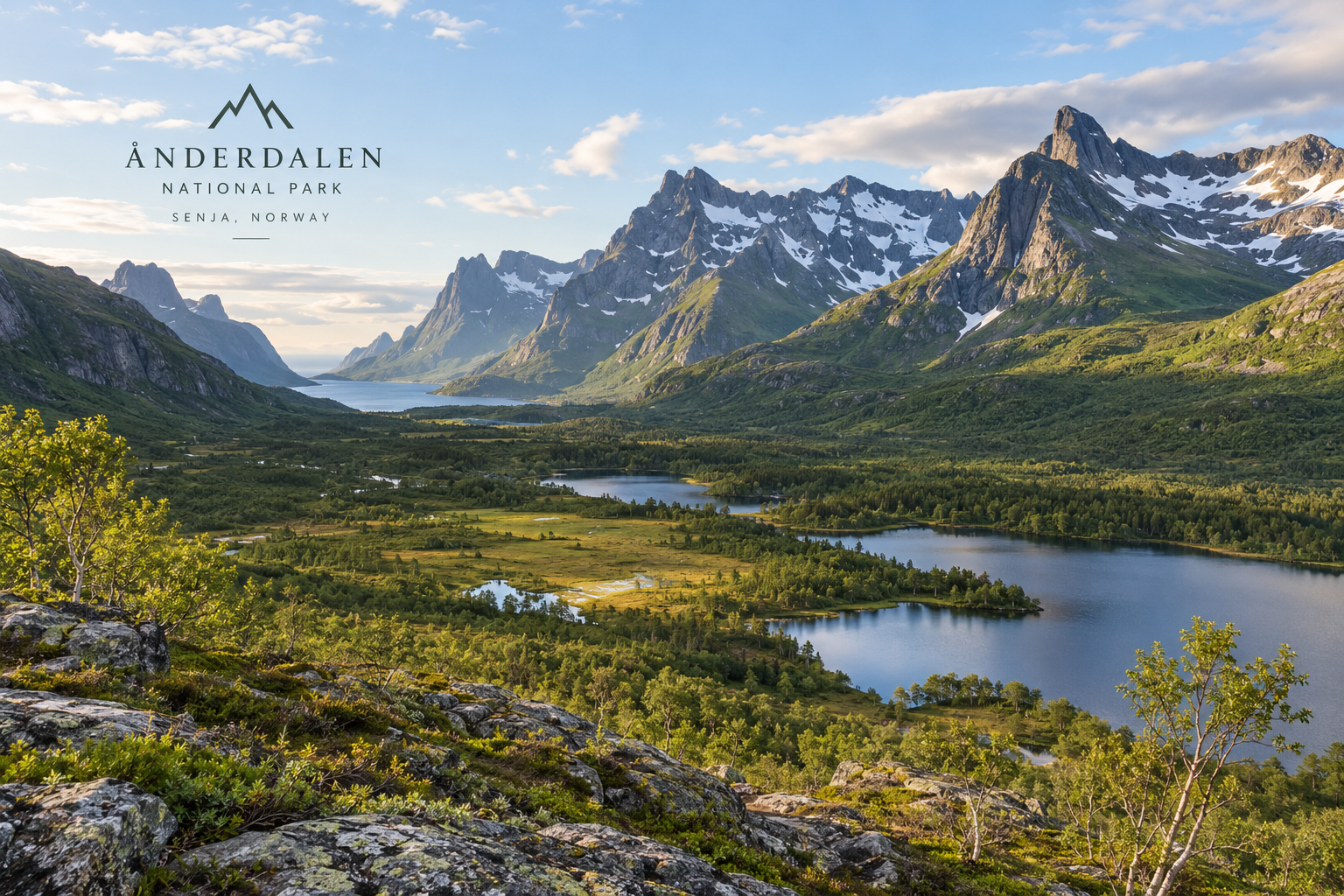
Ånderdalen National Park shows a very different side of Senja from the exposed mountains and fishing communities of the outer coast. The park protects 134 square kilometres of pine and birch forest, wetlands, rivers, lakes and mountain landscape in southern Senja, including old-growth pine trees that are more than 500 years old.
The contrast is one of the main reasons Ånderdalen is worth including. Instead of climbing quickly above a fjord for wide coastal views, you move through a quieter inland landscape where forest, water and wetlands dominate.
An Easier Way Into Senja’s Nature
You do not need to plan a demanding mountain hike to experience Ånderdalen. From the entrance at Tranøybotn, a universally designed trail runs for around two kilometres towards the boundary of the national park, with picnic areas and places to stop along the way. This makes Ånderdalen one of the most accessible places on Senja for travellers who want to spend time in nature without tackling the island’s steep summit hikes.
Longer trails continue further into the national park for those who want a more substantial hike or an overnight journey. Moose, foxes, hares and a variety of bird species live in and around the park, although wildlife sightings are never guaranteed.
6. Experience the Midnight Sun
Senja lies well above the Arctic Circle, and from roughly late May until late July the sun remains above the horizon throughout the night. During this period there is no true darkness, and the distinction between evening and morning becomes unusually fluid.
The experience is especially striking along Senja’s northern and western coast, where many viewpoints and beaches face towards the Norwegian Sea. Tungeneset and Ersfjordstranda are easy places to watch the light change late in the evening without committing to a hike, while a late drive along the outer coast can be just as memorable as visiting the same places during the middle of the day.
Hiking Under the Midnight Sun
Continuous daylight also changes how you can plan outdoor activities. Popular hikes such as Hesten can be started much later than you normally would, which can help you avoid some of the daytime traffic while experiencing the mountains in softer evening light.
The extra daylight does not make the mountains safer, however. Weather, wind and cloud still matter, and starting a hike late means being prepared to manage changing conditions even if darkness is not a concern.
Evening Kayaking and Boat Trips
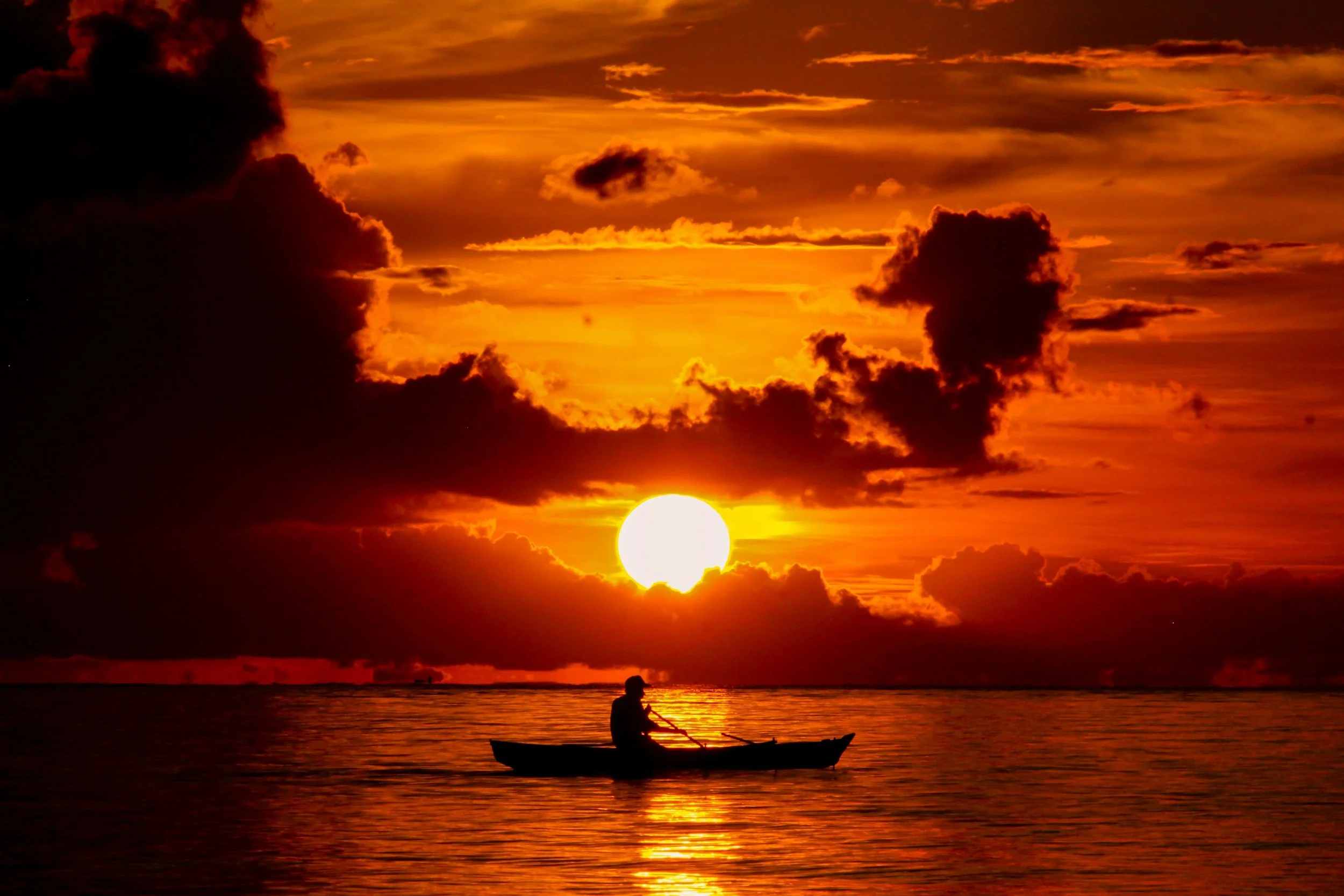
Being on the water late in the evening is another particularly good way to experience the Arctic summer. Kayaking through a fjord or travelling by boat while the mountains remain illuminated close to midnight gives a much stronger sense of the midnight sun than simply staying awake long enough to see the clock pass 00:00.
Some local operators also schedule evening excursions around the long summer light, so it is worth checking departure times if experiencing the midnight sun from the water is important to you.
The best way to experience it is not to treat midnight sun as a single sight that needs to be ticked off. Leave at least one evening relatively unplanned and use the light to stay outside longer than you normally would, whether that means walking, driving, sitting by the sea or heading onto the water.
7. See the Northern Lights
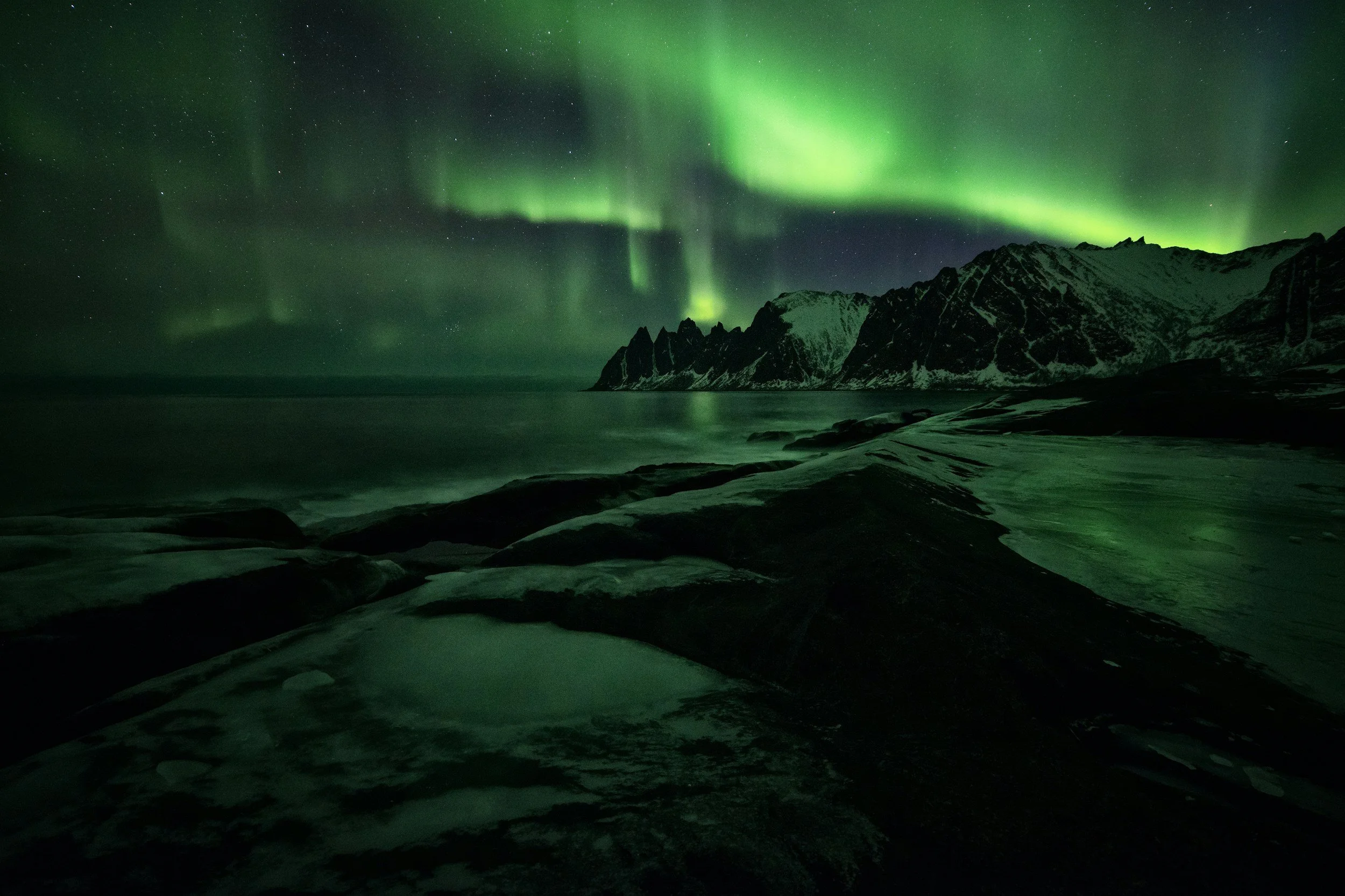
Once dark nights return after the bright Arctic summer, Senja becomes an excellent place to watch the northern lights. The island has relatively little artificial light outside its larger communities, while mountains, fjords and beaches provide dramatic foregrounds when the aurora appears.
You do not need to travel to a specific northern-lights attraction. On a clear night, the aurora can be visible from many parts of the island, and accommodation along the outer coast often places you within easy reach of dark surroundings.
Clear Skies Matter More Than the Perfect Location
The most important factor on Senja is often not finding the darkest possible viewpoint, but finding a gap in the cloud. Coastal weather can change quickly, and thick cloud will hide the aurora regardless of how strong the activity is above it.
This is why flexibility matters. Check both the aurora forecast and the local weather, and be prepared to move to another part of the island if conditions are better there. Spending several nights on Senja also gives you a much better chance than relying on one particular evening.
Guided or Independent?
Guided northern-lights tours can be useful if you are unfamiliar with Arctic weather, aurora forecasts or winter driving. A local guide can interpret the conditions and choose locations accordingly, but no tour can guarantee clear skies or an aurora display.
If you have your own car and are comfortable driving in the conditions, Senja is also very easy to explore independently. The island’s real advantage is not simply darkness, but the landscape beneath the aurora when the conditions come together.
For a broader explanation of the aurora season, the best regions and what actually improves your chances of seeing it, see When (and Where) to See the Northern Lights in Norway.
8. Go Ski Touring (Winter and Spring)
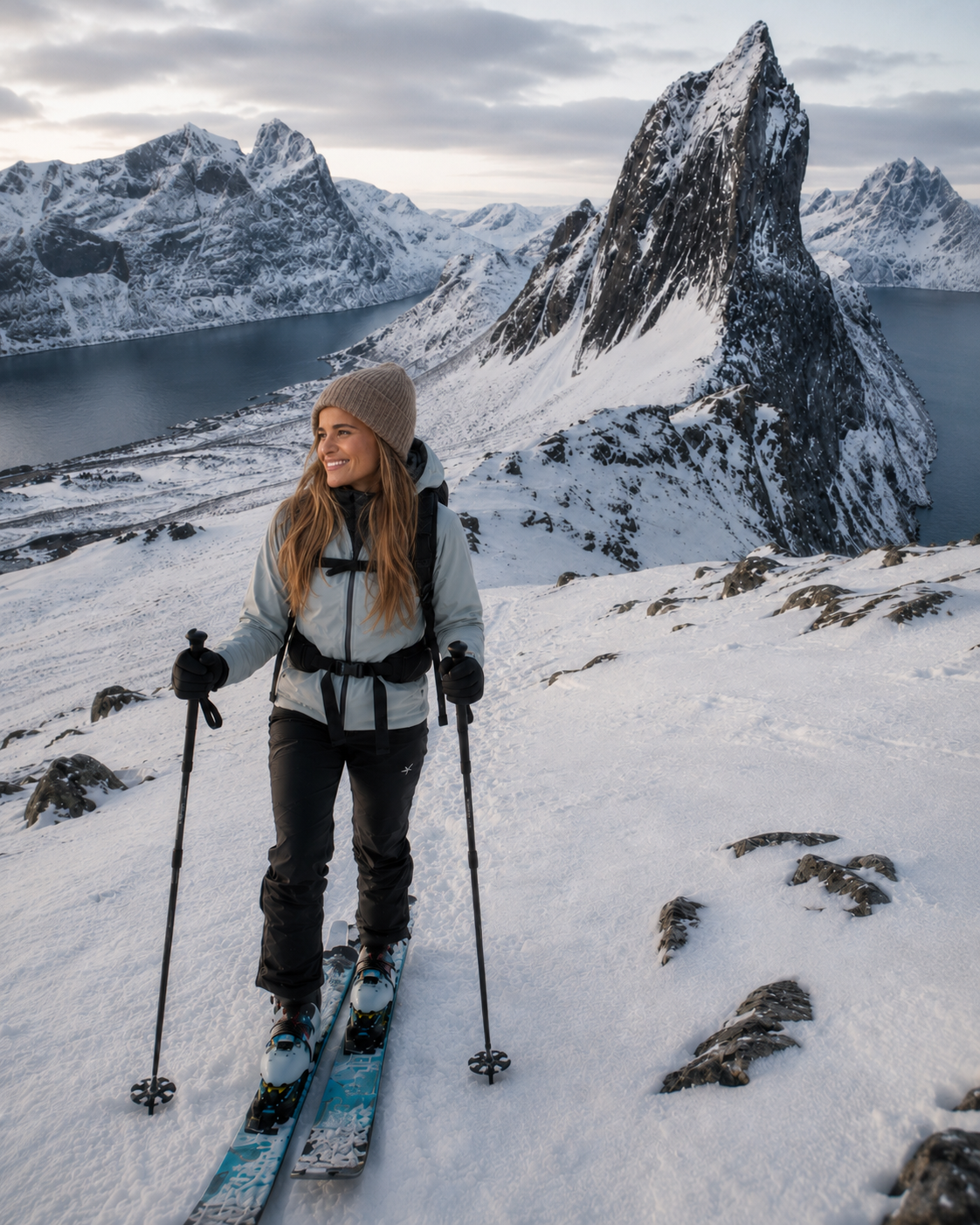
Senja has become an established ski-touring destination because its mountains rise almost directly from the fjords, creating routes where you can climb from close to sea level into alpine terrain with views across the coast.
The attraction is not simply the skiing itself, but the combination of steep mountains, ocean and relatively compact terrain. Depending on the route, a ski day can begin beside a fjord and finish high above the coastline, with views that feel completely different from Senja’s summer hiking season.
Choose the Route According to the Conditions
Senja’s mountains are serious winter terrain. Avalanche risk varies with snowfall, wind and temperature, and the most suitable route can change quickly from one day to the next. A mountain that looks straightforward on a map may also involve exposure to avalanche terrain on the approach or descent.
If you do not already have the knowledge required to assess snow conditions and choose safe terrain independently, I would strongly recommend joining a qualified local guide. Guided ski-touring trips are widely available during the winter and spring season and allow the route to be adapted to both the weather and your experience level.
The main ski-touring season extends through winter and into spring, when longer daylight makes full days in the mountains easier to plan. February and March are particularly attractive if you want a combination of reliable winter landscapes, increasing daylight and dark evenings that can still bring the northern lights.
Before heading into the mountains, always check the current avalanche forecast and conditions. Varsom is the official Norwegian service for avalanche warnings and is one of the most important tools for winter mountain travel in Norway.
9. Go Snowshoeing
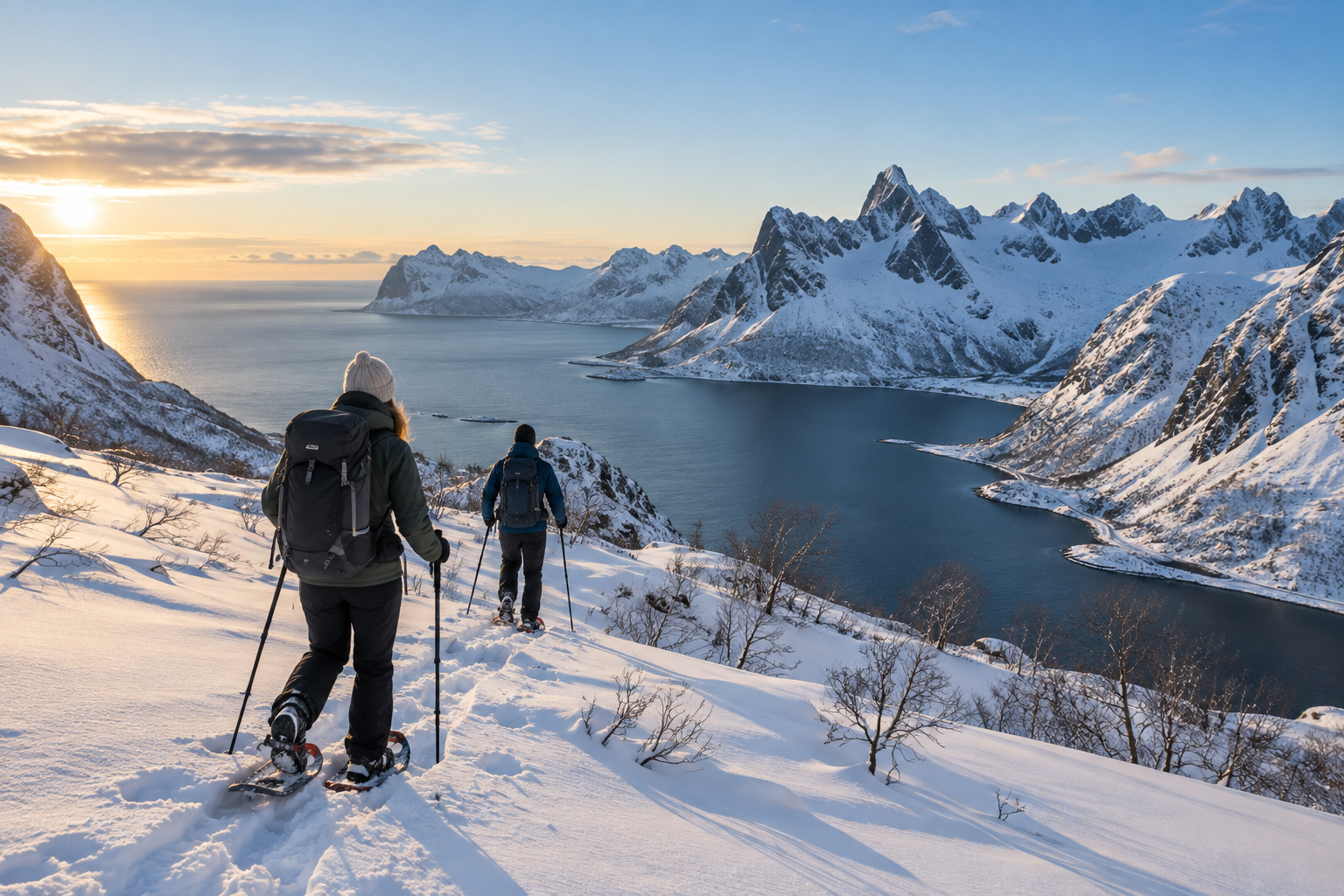
Snowshoeing is one of the most accessible ways to experience Senja’s winter landscape if you do not ski. It allows you to move through snow-covered forests, valleys and lower mountain terrain without needing the technical skills required for ski touring.
Guided snowshoe trips are available during the winter season, and equipment can also be rented in parts of the Senja region. Routes vary from easy walks through sheltered terrain to more demanding outings with views towards the mountains and fjords.
Snowshoeing is particularly useful on days when you want to spend time outdoors without committing to a full mountain day. It can also be a good option during periods of limited daylight, when a shorter winter activity fits more naturally into the hours available.
Even on relatively gentle terrain, winter conditions should be taken seriously. Deep snow, wind and rapidly changing weather can make a route more demanding than expected, and you should avoid travelling into or beneath avalanche terrain unless you understand the current conditions.
For most travellers without winter mountain experience, a guided snowshoe trip is the simplest way to explore safely while still getting away from the roads and settlements.
10. Discover Senja’s Cultural and Local History
Senja has been inhabited for thousands of years, and its history has been shaped by both the sea and the resources of the island itself. Norwegian fishing communities developed along the coast, while farming, hunting, forestry and mining have also supported settlements in different periods. Senja also has a long Sámi history, particularly in its inland areas. Together, these histories explain much more about the island than the landscapes alone.
Norwegian Coastal and Fishing History
The strongest historical thread across much of Senja is the relationship with the sea. Fishing shaped where communities developed, how people made a living and how settlements were connected to the rest of Northern Norway.
Skrolsvik in southern Senja is particularly interesting if you want to explore this history. The village has long been associated with fishing, especially halibut, and its small Halibut Museum preserves this part of the local fishing culture.
Nearby, Gammelbutikken gives a glimpse into everyday life in an old Northern Norwegian fishing community. The merchant’s house dates from the 1870s and once served not only as a shop but also as an office connected to fishing and shipping, with accommodation for fishermen upstairs. Today the building retains much of its historic character and operates partly as a small museum and café.
Farming and Rural Life
Fishing was rarely the only way families supported themselves. Along parts of the Senja coast, farming and fishing were traditionally combined, with households using both the sea and the limited agricultural land available around their settlements.
Hofsøya Rural Museum preserves part of this rural history and provides another perspective on life on Senja beyond the better-known fishing harbours and mountain landscapes.
Mining on Senja
Senja also has an industrial history that is easy to overlook. Mining became important around Skaland on the western side of the island, where mineral extraction created a very different kind of local economy from the fishing communities nearby.
The Mining Museum at Skaland introduces this part of Senja’s history and the nickel and graphite industries associated with the area.
Kaperdalen Sámi Museum
Senja also has a long Sámi history, particularly in the interior. One of the best places to learn about it is Kaperdalen Sámi Museum, which contains two former Sámi settlements and preserves a traditional inland cultural landscape.
The communities here combined small-scale farming, seasonal fishing and the use of surrounding forests, mountains, rivers and lakes. Traditional turf-covered buildings and traces of the former farms remain, while a trail connects the lower settlement at Ner-Kaperdalen with Øver-Kaperdalen.
Guided visits are available seasonally through Mid-Troms Museum, and Kaperdalen is particularly worthwhile if you want to understand how people lived in Senja’s interior rather than only visiting the communities along the coast.
Reindeer Husbandry
Reindeer husbandry remains part of life in the Senja region, and reindeer may sometimes be encountered along roads or in the mountains. Give the animals plenty of space, avoid approaching them for photographs and keep dogs under control.
You do not need to visit every museum on Senja, but including one or two historical stops gives the landscape much more context. Skrolsvik is particularly interesting for Norwegian coastal and fishing history, while Kaperdalen provides a very different perspective on life in the island’s interior.
11. Experience Senja’s Festivals and Local Events
Senja does not have a large year-round events calendar, but several local festivals take place during the warmer months. These are particularly interesting because they are closely connected to the communities that host them, offering a different perspective on the island from hiking, wildlife and sightseeing.
Kråkeslottfestivalen
Kråkeslottfestivalen is one of Senja’s best-known cultural events. The annual music and arts festival has been held for more than two decades and combines concerts with local culture, performance and other artistic events.
One of its distinctive features is that the festival can move between communities on Senja rather than remaining tied to one permanent venue. The programme and location therefore change from year to year, so check the current festival information if your summer trip coincides with the event.
Senja Kultur- og Fiskefestival
In Gryllefjord, Senja Kultur- og Fiskefestival reflects the community’s close relationship with fishing and coastal life. The festival has been running for decades and combines local traditions with entertainment and activities over several days.
If your visit overlaps with the festival, it can be an interesting addition to time spent exploring western Senja, particularly because it takes place within one of the island’s working fishing communities rather than at a purpose-built tourist attraction.
Smaller Community Events
Other communities around Senja organise smaller summer celebrations and local events. These can include everything from harbour festivals and village days to music, food and activities connected to fishing and coastal culture.
Families can also look out for Lyst heile natta – Senja Barnefestival, which combines cultural activities with outdoor experiences for children.
Festival dates, programmes and even locations can change from year to year, so always check what is happening during your specific travel dates. I would not necessarily plan an entire Senja trip around one of these events, but if your visit happens to coincide with a local festival, it can be one of the best opportunities to experience Senja as a community rather than only as a landscape.
The Norwegian Scenic Route Senja
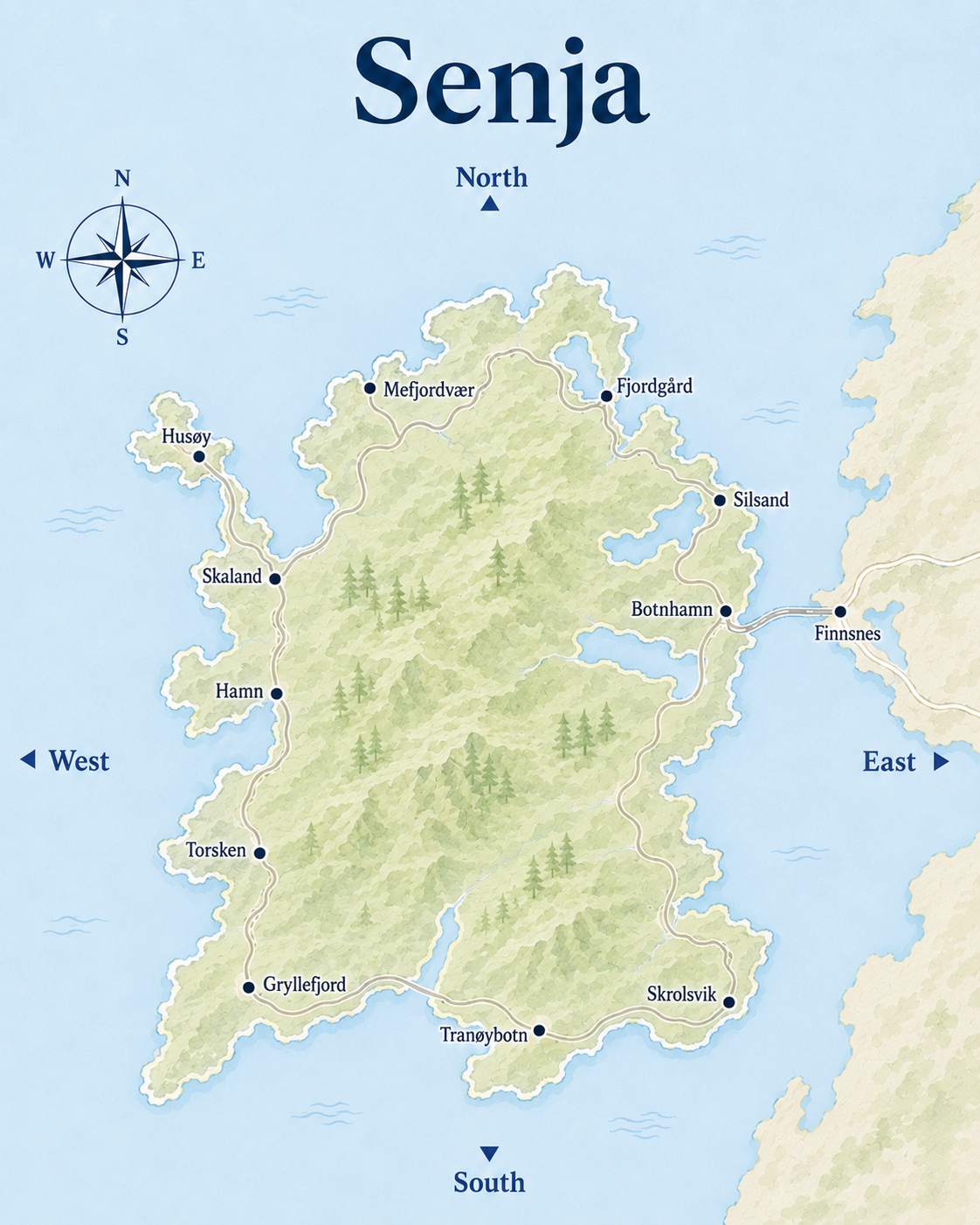
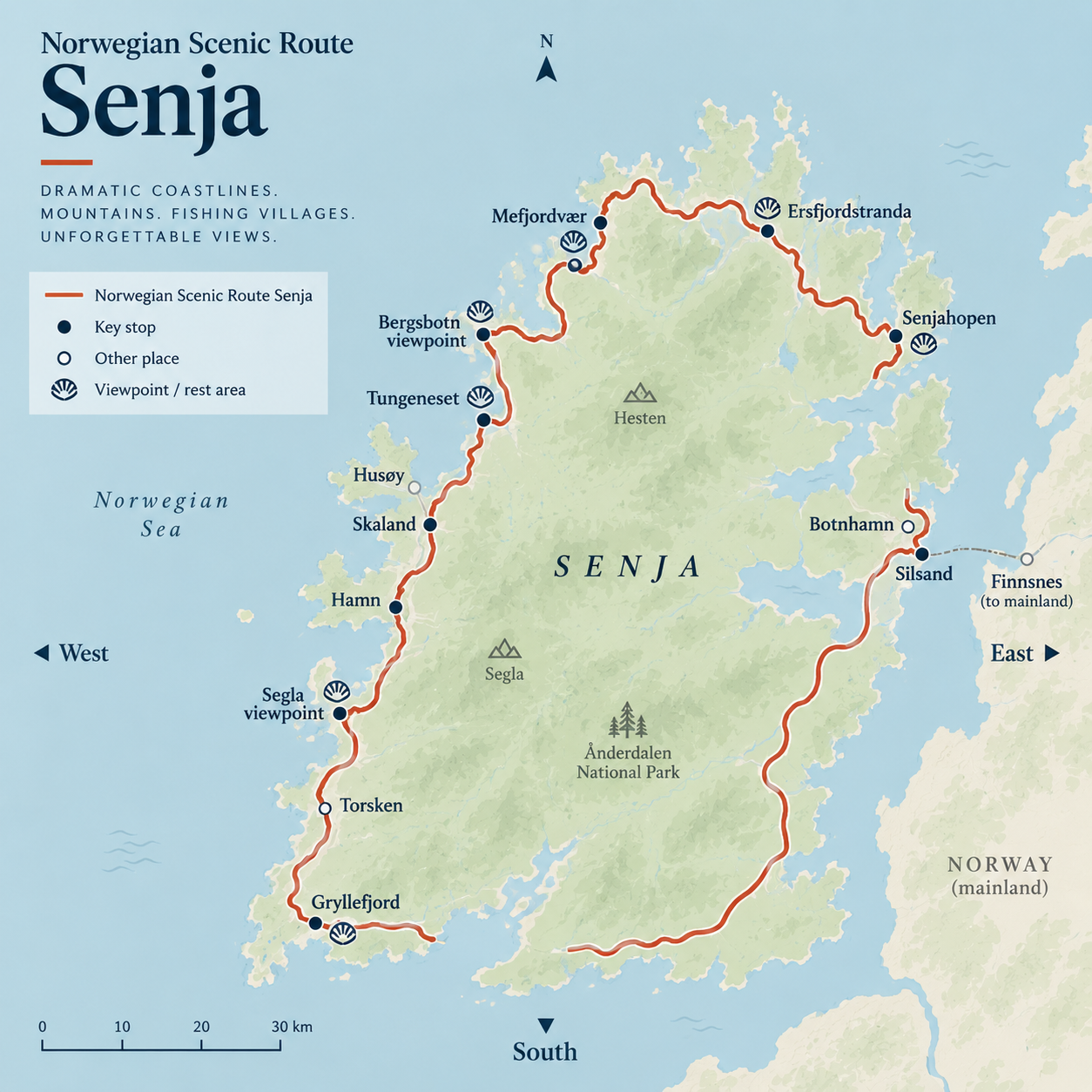
Norwegian Scenic Route Senja is one of 18 official Scenic Routes across Norway. These are ordinary public roads selected by the Norwegian Public Roads Administration for the landscapes they pass through, with specially designed viewpoints, rest areas, architecture and art added along the way. It is not a guided route or a separate attraction you need to book; you simply drive it as part of your journey around Senja.
The route covers 102 kilometres between Botnhamn in the north and Gryllefjord in the west, following much of Senja’s dramatic outer coastline. Short detours also lead towards communities such as Husøy and Mefjordvær.
Tungeneset
Tungeneset is one of the most recognisable stops on Senja. A wooden walkway leads across the rocky headland towards open views of the Norwegian Sea and the jagged Okshornan peaks across the fjord.
Ersfjordstranda
Ersfjordstranda is a white sandy beach surrounded by steep mountains at the head of Ersfjord. Rather than treating it purely as a photo stop, allow some time to walk along the beach and experience the setting from sea level.
Bergsbotn
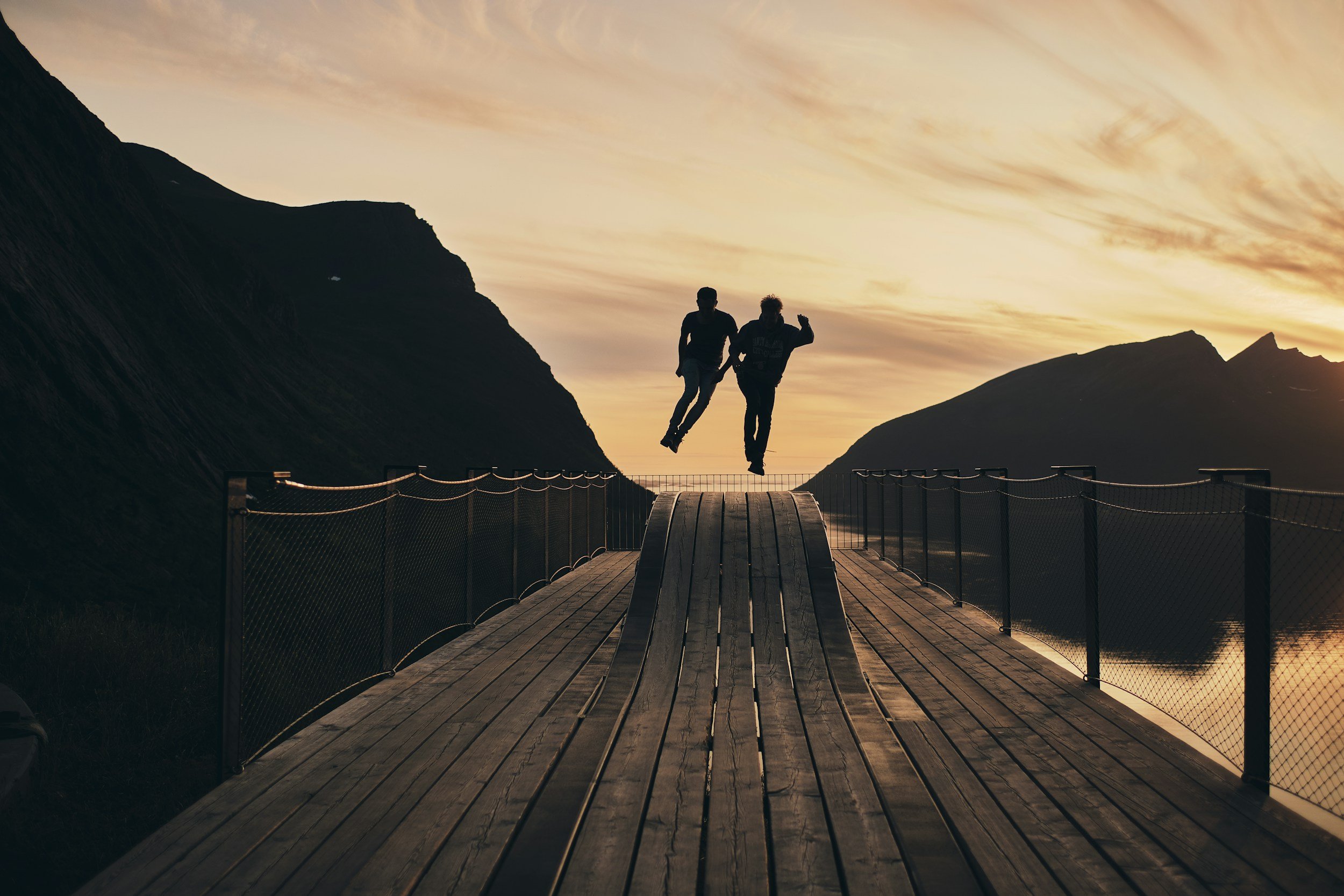
At Bergsbotn, a 44-metre viewing platform extends from the mountainside above Bergsfjord. It provides one of the easiest elevated views on Senja, with the fjord and surrounding mountains spread out below without requiring a hike.
Bøvær and Bergsfjorden
Around Bøvær and Bergsfjorden, the landscape opens into beaches, small islands and skerries. This section feels noticeably different from the steep enclosed fjords elsewhere along the route and shows another side of Senja’s western coast.
Detours to Mefjordvær and Husøy
Both Mefjordvær and Husøy require short detours from the main Scenic Route, but they are worth considering if you want to combine the famous viewpoints with Senja’s coastal communities. Both have already been covered earlier in this guide, so I would think of them as extensions of the road trip rather than additional Scenic Route attractions to tick off.
The Scenic Route ends at Gryllefjord, where the seasonal ferry to Andenes on Andøya provides a natural continuation towards Vesterålen during summer. You do not need to drive all 102 kilometres in a single day. The route works much better as the road connecting different experiences around western and northern Senja than as something that needs to be “completed”.
Where to Eat on Senja
Food on Senja is closely connected to the surrounding sea, and seafood is the obvious place to start. Cod, halibut and other local fish appear frequently on menus, while restaurants also make use of ingredients such as lamb, reindeer, potatoes and seasonal produce from Northern Norway.
If you want more context on the dishes and traditions you may encounter while travelling, Norwegian Food: The Dishes, Desserts and Traditions That Define Norway gives a broader introduction to Norwegian food culture.
Senja by Heart, Torsken
Senja by Heart is one of the strongest choices if you want dinner to be part of the experience rather than simply somewhere convenient to eat. The restaurant focuses on locally sourced ingredients, with seafood coming from processing facilities nearby, and the menu is closely connected to the surrounding fishing community.
This is one of the places I would book in advance, particularly if you are staying around Torsken or travelling through western Senja.
Salteriet Restaurant & Bar, Mefjordvær
Salteriet at Mefjord Brygge is a good choice when exploring northern Senja. The kitchen focuses on Northern Norwegian food and local ingredients, with seafood playing an important role, but the restaurant also caters for vegetarian, vegan and other dietary requirements with advance notice.
Its location makes it particularly convenient if you are staying in Mefjordvær or combining the northern coast with hiking and the Scenic Route.
The Fat Cod, Steinfjord
The Fat Cod at Camp Steinfjord offers breakfast, lunch and dinner in a waterfront setting on western Senja. The menu combines local seafood with more casual dishes, making it a useful option if you want somewhere less formal than a destination dinner.
The restaurant is open year-round and works particularly well as a stop while travelling between Bergsfjorden, Steinfjord and the western Scenic Route.
Storbrygga Spiseri, Hamn
At Hamn i Senja, Storbrygga Spiseri serves Arctic and local ingredients in a restaurant directly beside the harbour. It is particularly convenient if you are staying at Hamn, but non-residents can also book meals there.
The waterfront setting makes this one of the more atmospheric places to eat on western Senja, particularly during the long summer evenings.
Senja does not have restaurants distributed evenly around the island, so I would plan dinner a little more carefully than I would in a larger destination. Check current opening hours before travelling, especially outside summer, and book ahead if there is somewhere you particularly want to eat rather than assuming another restaurant will be available nearby.
Where to Stay on Senja
Accommodation on Senja ranges from conventional hotels to waterfront cabins, self-catering apartments, private holiday homes and campsites. You do not need to choose one particular style to experience the island properly, but the type of accommodation can make quite a difference to the trip, especially if you are staying for several nights.
Hotels and Lodges
Senja has a small selection of hotels and larger accommodation properties, although even these tend to feel much smaller and more closely connected to the landscape than conventional city hotels.
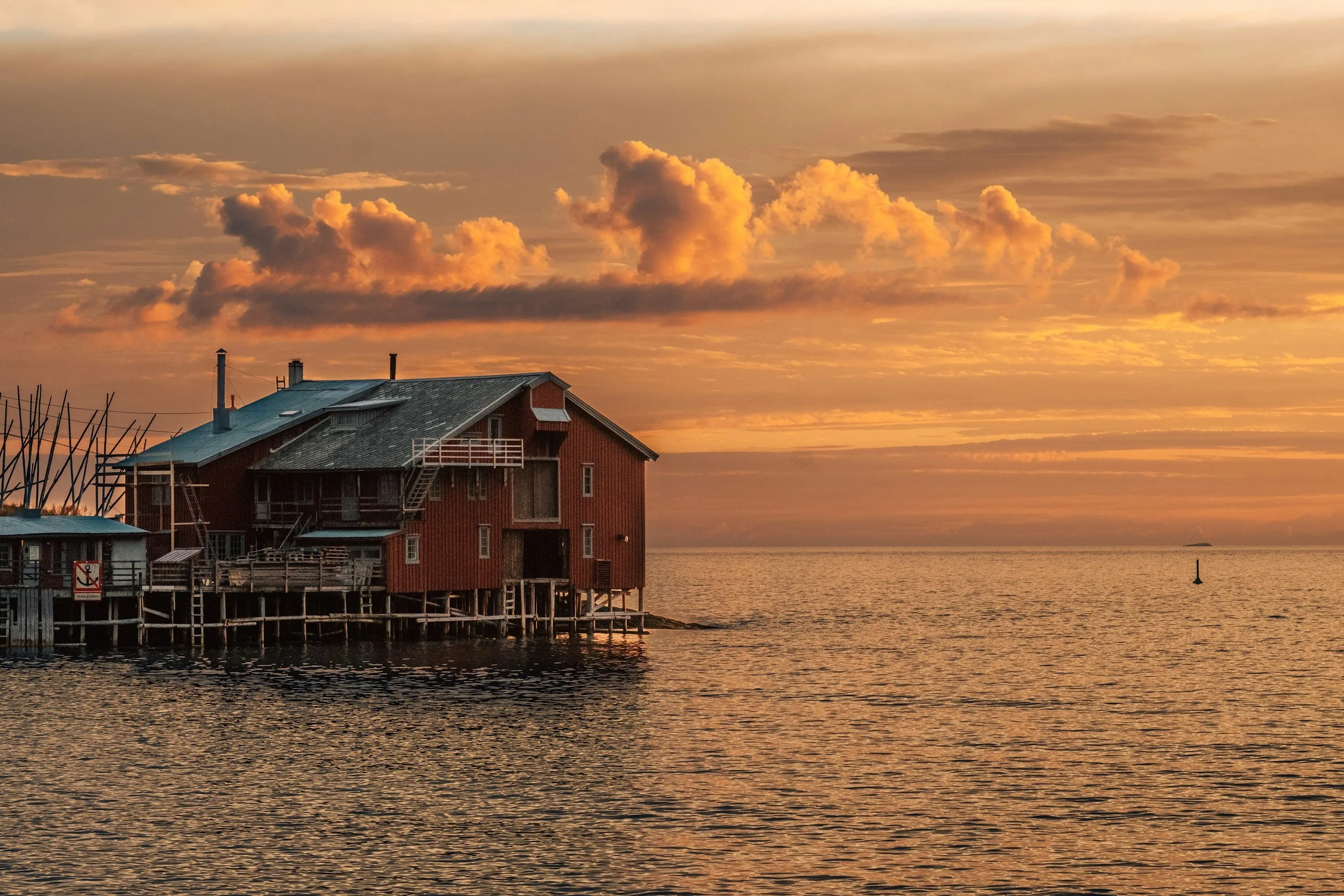
Hamn i Senja is one of the best-known places to stay on the island. Located directly on the waterfront at Hamn, it offers rooms, suites and apartments alongside a restaurant and organised activities. It is one of the more complete accommodation options on Senja if you want a higher level of comfort and several facilities in one place.
Mefjord Brygge in Mefjordvær is another long-established option on the outer coast. It offers hotel rooms as well as apartments and cabins, making it particularly useful if you want the services of a hotel but still prefer the option of self-catering or more space.
Further south, Senja Fjordhotell offers a quieter hotel experience in a very different part of the island, away from the dramatic northern coastline that dominates most photographs of Senja.
Cabins and Rorbuer
Cabins are one of the most appealing ways to stay on Senja, particularly if you want more space, your own kitchen and a closer connection to the landscape. Many are positioned beside the sea or fjords, and options range from simple traditional-style cabins to modern properties with large windows and considerably more comfort.
Some established accommodation providers offer cabins alongside hotel rooms. Senja by Heart in Torsken, for example, has waterfront cabins at Senja Fjordcamp as well as rooms elsewhere in the village, while Mefjord Brygge has several sizes of cabins and waterfront apartments.
Cabin stays also fit naturally into the wider Norwegian tradition of spending time in a hytte. If you are interested in why cabins have such an important place in Norwegian life beyond simply being holiday accommodation, Norwegian Cabin Culture explores that tradition in more depth.
Apartments, Holiday Homes and Airbnb
There is also a good selection of self-catering apartments and privately rented houses around Senja, including properties listed through Airbnb and other booking platforms. These can be particularly useful for longer stays, families or groups, and for travellers who prefer to cook some of their own meals.
Private rentals can also give you access to smaller communities where there may be no conventional hotel at all. The trade-off is that facilities and services vary much more from property to property, so check the exact location carefully before booking. A house that looks close to the places you want to visit on a map may still involve a substantial drive around a fjord or mountain.
Camping and Campervans
Camping is another option, with several campsites around Senja offering space for tents, campervans and motorhomes. Some also have cabins, allowing groups travelling together to combine different types of accommodation.
If you are travelling with a campervan, use established campsites and designated overnight areas where appropriate rather than assuming every attractive roadside parking area is suitable for overnight camping. The Norwegian Right to Roam Explained covers the rules around camping and access to nature in Norway in more detail.
Accommodation on Senja therefore ranges from hotels and lodges to cabins, self-catering apartments, private holiday homes and campsites. The choice is broad enough that you can usually find something that suits the way you want to travel, whether you prefer full-service accommodation, more independence or a simple place close to nature.
When Is the Best Time to Visit Senja?
The best time to visit Senja depends on the kind of trip you want. Summer offers the widest access to hiking, the coast and long days outdoors, while autumn brings darker nights and changing colours. Winter and spring transform the island completely, with snow, ski touring and northern lights replacing the almost continuous daylight of summer.
May and June
Late May and June bring some of the longest and brightest days of the year. Senja experiences the midnight sun from approximately 20 May to 24 July, so darkness is effectively removed from the equation during this period.
June is particularly appealing if the midnight sun and long evenings are central to your trip. Lower coastal areas are already green, but snow can remain on higher mountain routes, and hiking conditions vary considerably from one year to another. If high-mountain hiking is a priority, check current conditions rather than assuming every route will be ready simply because summer has begun.
July
July is the most straightforward summer month if you want the broadest range of experiences available at the same time. Hiking is generally more established, summer boat and sea activities are operating, and the midnight sun continues through most of the month.
The trade-off is that July is also the main summer season. Popular hikes, accommodation and the best-known stops along the Scenic Route are likely to be busier than in June or September.
August
August is one of the most interesting months on Senja because it sits between Arctic summer and the return of darker nights. Hiking and sea-based activities remain possible, while the light begins to change noticeably as the month progresses.
By late August, the nights can become dark enough for the northern lights to return. This makes August particularly attractive if you want a summer-style trip during the day without giving up the possibility of seeing the aurora at night.
September
September brings a more obvious shift into autumn. Forests and low vegetation begin to change colour, nights are properly dark again and visitor numbers generally fall after the summer peak.
The compromise is less predictable weather and reduced seasonal services. Some operators begin cutting back their schedules, while wind, rain and lower temperatures can make exposed hikes and sea activities more dependent on the conditions.
September is therefore particularly appealing if autumn landscapes, photography and northern lights matter more than having the widest possible choice of summer activities.
Winter and Spring
Winter on Senja is a completely different journey from summer. Snow covers the mountains and much of the landscape, northern lights are possible during the dark hours, and activities such as ski touring and snowshoeing become part of the trip.
December and January have the most limited daylight, creating a much darker Arctic experience. By February and March, daylight returns rapidly while the mountains remain in winter conditions, making these months particularly attractive for travellers who want snow and winter activities without spending most of the day in darkness.
Spring gradually brings longer days while the mountains can remain snow-covered well beyond the point when lower areas begin to thaw, which is one reason the ski-touring season can extend well beyond the darkest months of winter.
There is therefore no single month that works best for every Senja trip. June is particularly strong for the midnight sun, July for the broadest summer experience, August for the transition between summer and darker nights, September for autumn and northern lights, and February or March for a winter trip with substantially more daylight.
If Senja is only one part of a longer journey and you are still deciding when to travel to Norway as a whole, Best Time to Visit Norway: A Seasonal Overview compares weather, daylight and travel conditions across the country throughout the year.
How to Get to Senja
Senja is an island, but it is connected to mainland Norway by the Gisund Bridge at Finnsnes, so you do not need to take a ferry to reach it. The most convenient route depends on where you are travelling from, and during summer the surrounding ferries create several useful alternatives to the year-round road connection.
From Tromsø
Tromsø is a common starting point for a journey to Senja. If you are driving, the year-round route runs south through mainland Northern Norway towards Finnsnes before crossing the Gisund Bridge onto the island. From Tromsø to Finnsnes, the drive takes roughly three hours before adding the journey onwards to your accommodation on Senja.
Another option is the Brensholmen–Botnhamn ferry, which operates year-round. Brensholmen lies on Kvaløya west of Tromsø, while Botnhamn is at the northern end of the Norwegian Scenic Route Senja. This route is particularly convenient if you are heading directly towards northern or western Senja rather than entering the island through Finnsnes.
A passenger express boat also connects Tromsø and Finnsnes. This can work well for travellers without a car, although you will still need onward transport from Finnsnes to most destinations on Senja.
From Vesterålen
In summer, the Andenes–Gryllefjord ferry connects Andøya in Vesterålen directly with western Senja. The crossing takes you across Andfjorden and arrives at Gryllefjord, close to the western end of the Scenic Route.
This makes the ferry particularly useful as part of a longer coastal journey through Northern Norway. Outside the operating season, you need to travel by road through Vesterålen and the mainland before entering Senja via Finnsnes.
From Lofoten
There is no direct ferry between Lofoten and Senja. The Andenes–Gryllefjord ferry is sometimes described loosely as a Lofoten–Senja connection, but Andenes is on Andøya in Vesterålen.
If you are travelling north from Lofoten during summer, the natural route continues through Vesterålen and along Andøya to Andenes before taking the ferry to Gryllefjord. Senja and Lofoten can therefore be combined very well, but the journey between them should be treated as part of a wider Northern Norway road trip rather than a short transfer between neighbouring destinations.
By Air
Senja does not have a commercial airport. Tromsø Airport is the most useful arrival point for many travellers because it has a wider range of domestic and international connections and gives access to both the mainland road route and the summer ferry from Brensholmen.
Bardufoss Airport is closer to Finnsnes and can also be convenient, particularly if you are renting a car and entering Senja across the Gisund Bridge. Flight options are more limited than at Tromsø, so the better airport will depend on the rest of your journey.
The Brensholmen–Botnhamn and Andenes–Gryllefjord ferries are seasonal connections, so always check the current timetable before building either into your route.
Getting Around Senja
For most travellers, a car is the easiest way to explore Senja. The island is large, communities and trailheads are spread around different fjords, and public transport is designed primarily around local connections rather than sightseeing. Visit Senja also recommends travelling by car if you want to explore different parts of the island independently.
Driving Around Senja
Distances on Senja can be deceptive. Mountains and fjords determine where roads can go, so two places that appear close together on a map may require a much longer journey around the coast or through the interior.
This is a common issue when planning road trips throughout Norway, not only on Senja. Driving Distances in Norway: What Visitors Often Underestimate explains why relatively short distances can translate into much longer travel times than visitors expect.
Most roads on Senja are paved, including the Norwegian Scenic Route, but many are narrow and winding. Tunnels, changing speed limits and sections where passing another vehicle requires more care are normal parts of driving around the island. The journey itself is rarely difficult in good conditions, but it is worth allowing more time than the number of kilometres alone suggests.
For Norwegian road rules, tolls, ferries, tunnels, parking and other practical information, see Driving in Norway: Everything You Need to Know.
Can You Visit Senja Without a Car?
Yes, although it requires more planning. Finnsnes acts as the main public-transport hub, with buses connecting it to communities including Gryllefjord, Senjahopen and Stonglandseidet. Many journeys between different parts of Senja involve travelling via Finnsnes or changing buses, which makes public transport much less flexible for a sightseeing-focused trip.
A car-free trip works best if you choose one or two bases rather than trying to move around the entire island. Some accommodation providers can also arrange transfers to activities or pick-up from transport connections, which can make staying without a car considerably easier.
Seasonal tourist transport can provide additional options. Summer services connect Tromsø, Senja, Vesterålen and Lofoten, while dedicated winter routes have also operated between Tromsø and several communities on Senja. These services change by season, so check the current timetable when planning the trip.
Driving on Senja in Winter
Winter changes the driving conditions considerably. Snow, ice, wind and coastal weather can affect both roads and journey times, while conditions may vary between different parts of the island on the same day.
If you are travelling during the colder months, Driving in Norway in Winter covers winter tyres, snow and ice, road conditions and the additional planning involved in a Norwegian winter road trip.
Combining Senja with Tromsø, Vesterålen and Lofoten
Senja combines particularly well with Tromsø, Vesterålen and Lofoten, but these destinations should be treated as part of a longer journey through Northern Norway rather than places that can all be squeezed into a few days.
Tromsø and Senja make the simplest combination. Tromsø adds restaurants, museums and a much wider range of organised activities, while Senja shifts the focus towards mountains, wildlife, the coast and smaller communities. If you have around a week, 7 Days in Northern Norway: A Realistic Arctic Itinerary shows how to combine Tromsø and Senja without trying to include too much of Northern Norway in the same trip. You can also use the Tromsø Travel Guide if you are spending several days in the city before or after Senja.
If you have more time and want to continue south, Tromsø, Senja and Lofoten Road Trip follows the full coastal journey from Tromsø through Senja, Andøya and Vesterålen to Lofoten, including the ferries, realistic driving times and the places worth stopping along the way..
Vesterålen creates the natural continuation south from Senja when the seasonal Gryllefjord–Andenes ferry is operating. I would treat Vesterålen as part of the journey rather than simply a road between Senja and Lofoten, particularly if you are interested in coastal landscapes, wildlife and smaller communities.
From Vesterålen, the route continues naturally into Lofoten. Senja and Lofoten are different enough that visiting both does not feel repetitive, but you need enough time to experience the journey between them rather than thinking of one as a quick extension of the other. Lofoten Travel Guide covers the islands in more detail, while Senja: The New Lofoten? compares the two destinations directly.
For a broader overview of how Senja, Tromsø, Vesterålen and Lofoten fit together within the region, see the Northern Norway Travel Guide.
Practical Things to Know Before Visiting Senja
Senja is straightforward to travel around independently, but it is still a sparsely populated island with services spread between relatively small communities. You do not need to plan every detail in advance, although a little preparation is useful if you are staying along the outer coast or travelling outside the main summer season.
Groceries and Supplies
Finnsnes, immediately across the Gisund Bridge, has the largest concentration of shops and services in the area, with additional grocery stores in communities around Senja.
If you are staying in a cabin or self-catering accommodation, it can be useful to do a larger shop when you pass one of the bigger supermarkets. Smaller local shops are useful for everyday supplies, but opening hours and selection can be more limited, particularly outside summer.
Fuel and EV Charging
Fuel and EV charging are available around Senja, but stations are naturally less frequent than in more populated parts of Norway. If you are driving extensively around the island, check where your next fuel or charging stop is rather than waiting until you urgently need one.
Book Activities and Restaurants Ahead
Many of Senja’s guided experiences are operated by relatively small local companies, so whale safaris, kayaking, fishing trips and other excursions can fill up during busy periods.
The same applies to restaurants. Senja does not have a large choice of restaurants in every community, and some operate seasonally or with reduced opening hours. If there is a particular experience or restaurant you do not want to miss, booking ahead is sensible.
Check Seasonal Opening Hours and Transport
Senja changes considerably through the year. Restaurants, museums, guided activities and other visitor services may operate different schedules outside summer, while seasonal transport such as the Gryllefjord–Andenes ferry does not run year-round.
Always check current opening hours and timetables when planning the trip, particularly during spring and autumn.
Keep Your Plans Flexible
Weather can be very different on opposite sides of Senja. Low cloud might make a mountain hike pointless while conditions remain perfectly suitable for exploring the coast, visiting Ånderdalen or doing something in one of the island’s communities.
Rather than assigning every outdoor activity to a fixed day far in advance, keep enough flexibility to move things around according to the conditions.
Useful Apps for Senja
Yr is useful for checking the weather throughout the trip. Search for the specific place you are visiting rather than relying on one general Senja forecast, as conditions can differ significantly around the island.
Vegvesen trafikk provides current road and traffic information, road webcams and alerts. It is particularly useful when driving in winter or during poor weather.
Entur is Norway’s national journey planner and is useful for checking buses and other public transport if you are travelling without a car.
Varsom provides avalanche forecasts and terrain information and is particularly important for ski touring and other winter mountain activities.
For the northern lights, an aurora app such as Hello Aurora can help you follow current activity, but always use it alongside the weather forecast. A strong aurora forecast will not help if Senja is covered by cloud.
If you are travelling by campervan or motorhome, Park4Night can be useful for finding campsites, facilities and possible overnight stops. An entry in an app does not automatically mean overnight camping is permitted, however, so always check signs and local restrictions. The Norwegian Right to Roam Explained covers Norway’s rules around wild camping and access to nature in more detail.
Final Words
Senja is often introduced through a handful of spectacular images: Segla rising above the fjord, the sharp peaks of Okshornan or a road winding between mountains and the sea. Those landscapes deserve their reputation, but they only show one side of the island.
What makes Senja particularly interesting is the variety behind those famous views. The exposed outer coast gives way to fishing communities, sheltered fjords, forests, wetlands and inland cultural landscapes, while the sea remains central to both the scenery and everyday life. A trip can be built around hiking, wildlife, fishing, winter activities, food or simply moving slowly through very different parts of the island.
Senja is therefore much more than a collection of viewpoints and famous hikes. If you are looking for a Northern Norway destination where dramatic landscapes are combined with wildlife, coastal culture and enough variety to fill several very different days, Senja is one of the strongest choices you can make. Come for the mountains if that is what first catches your attention, but give yourself enough freedom to explore beyond them.
More articles about Norway:
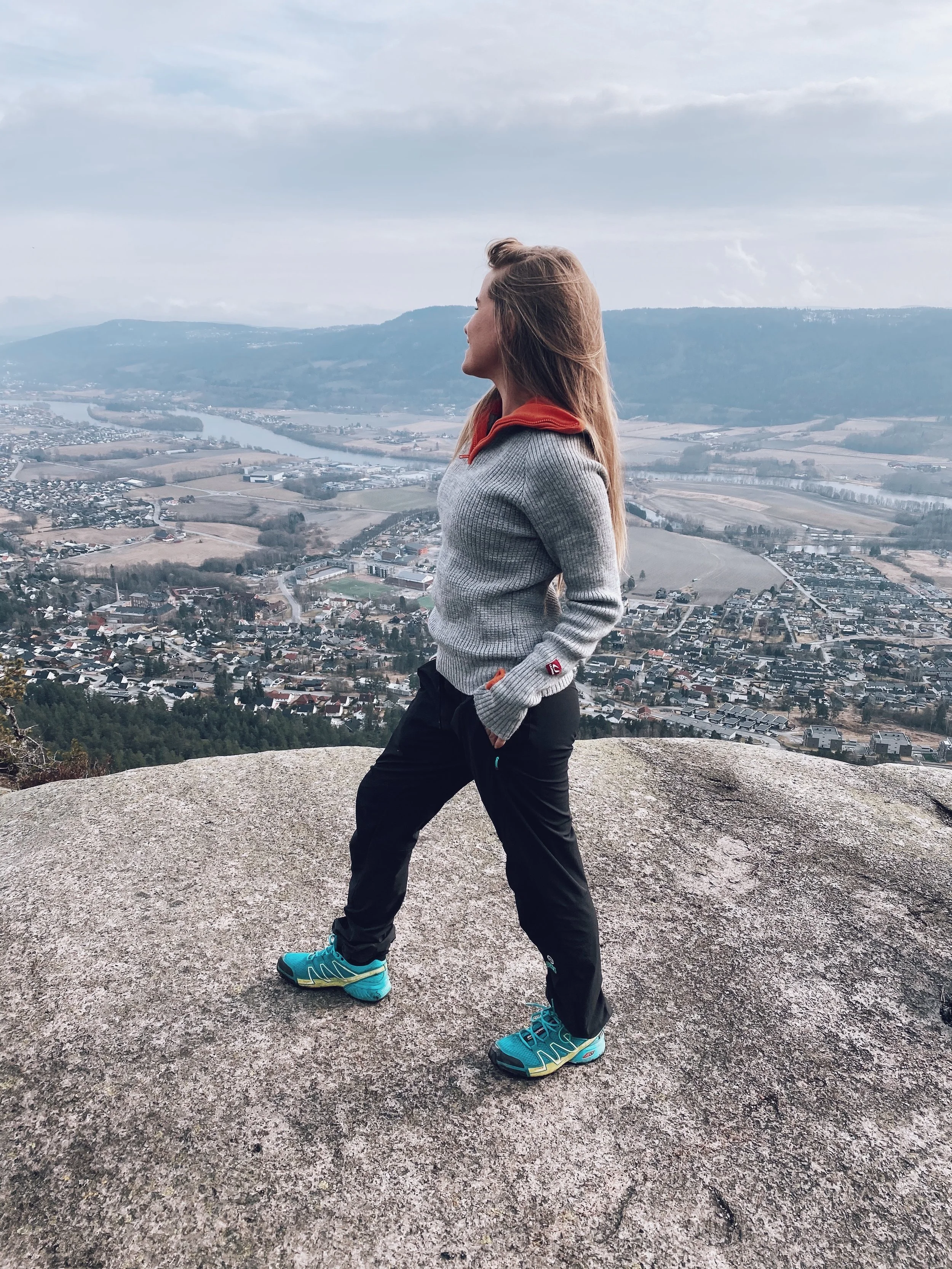
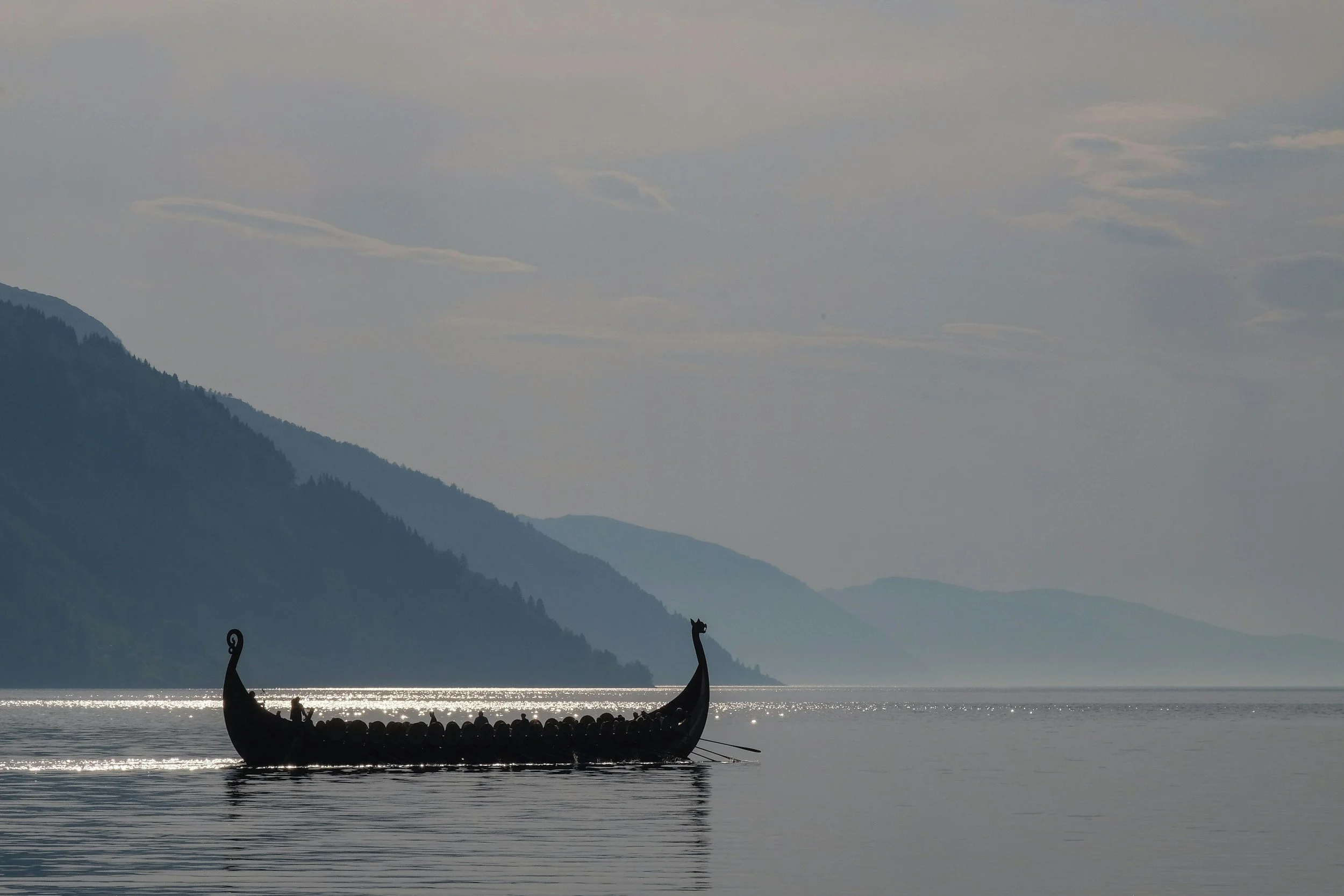
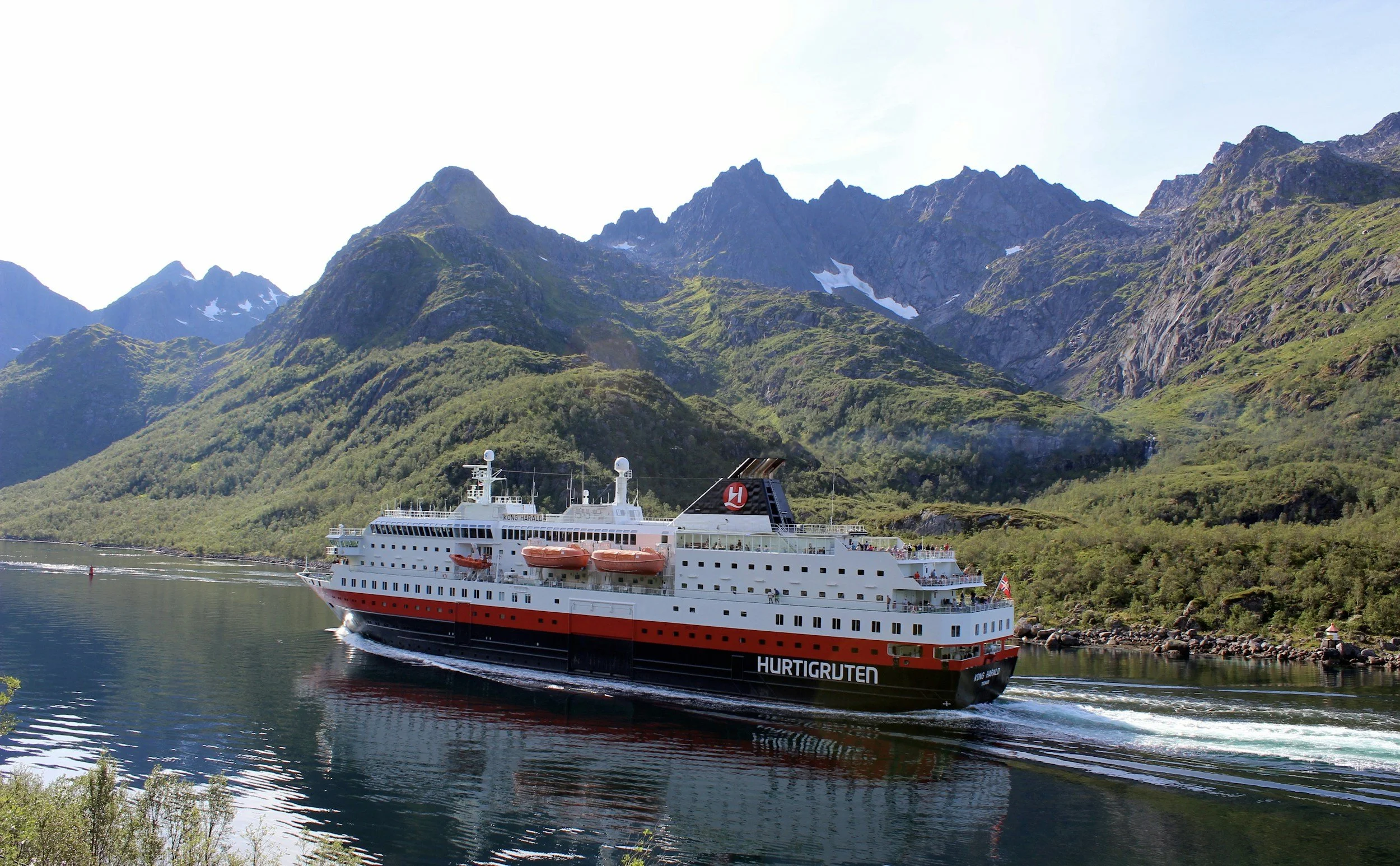
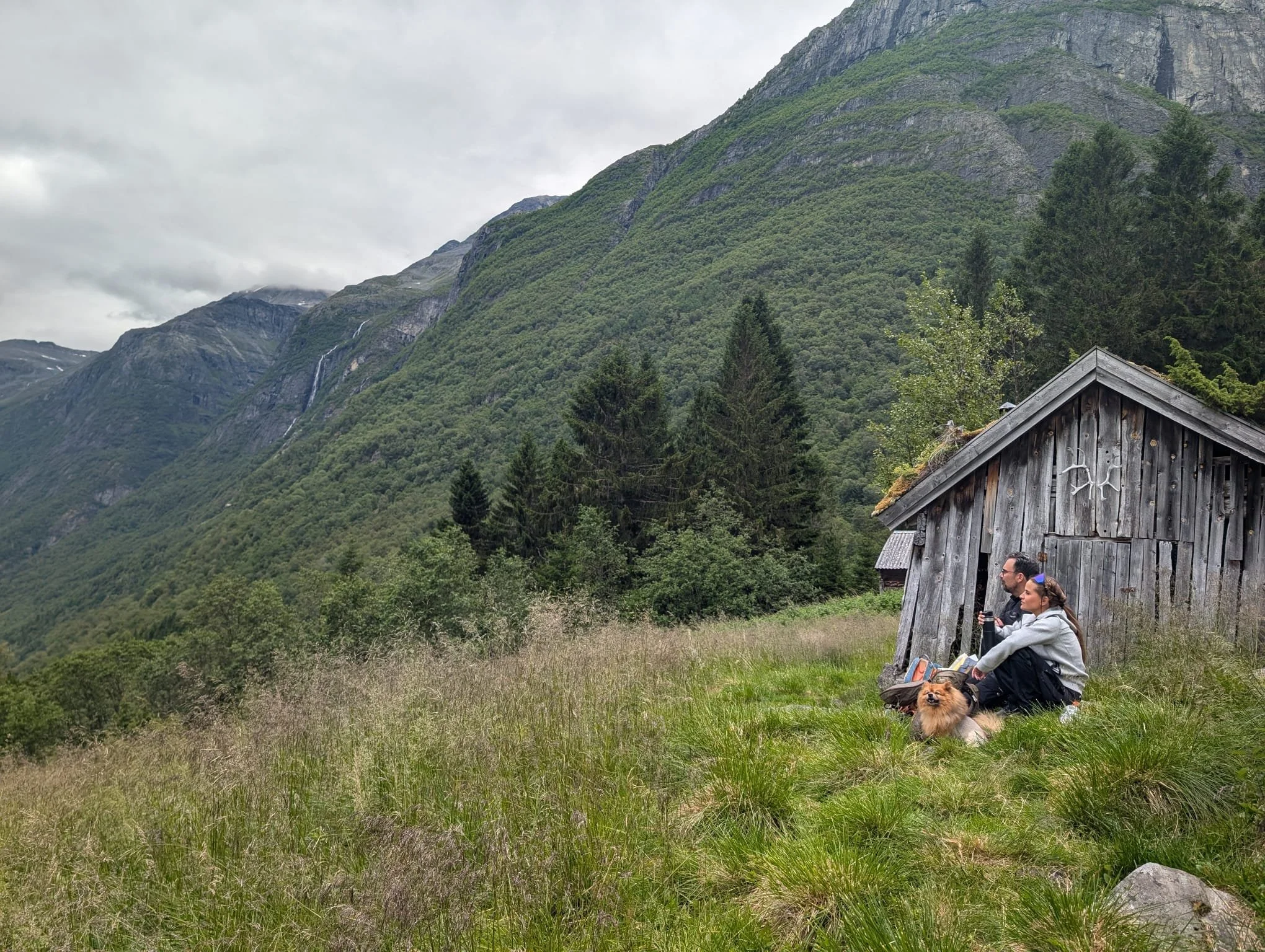
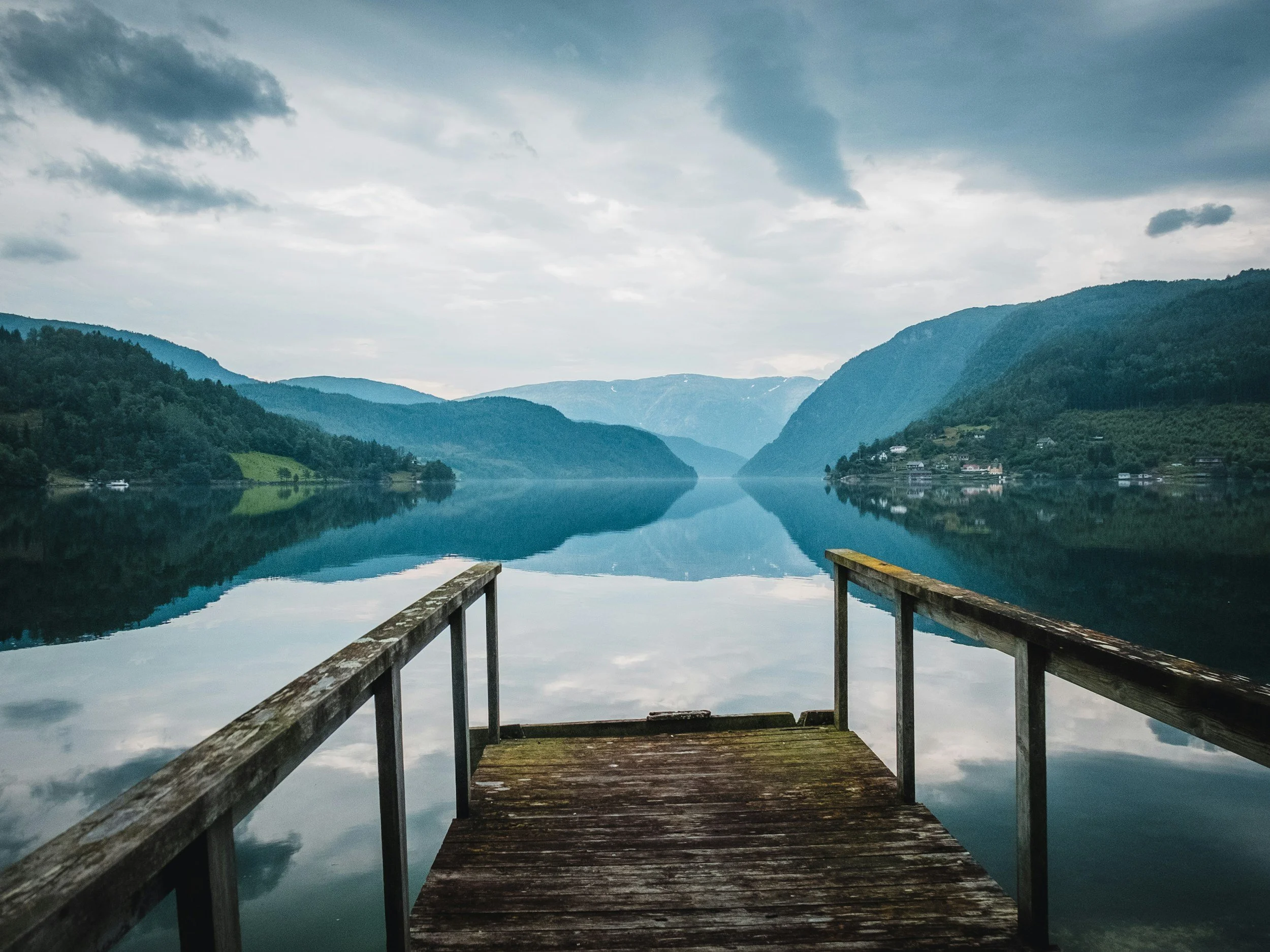
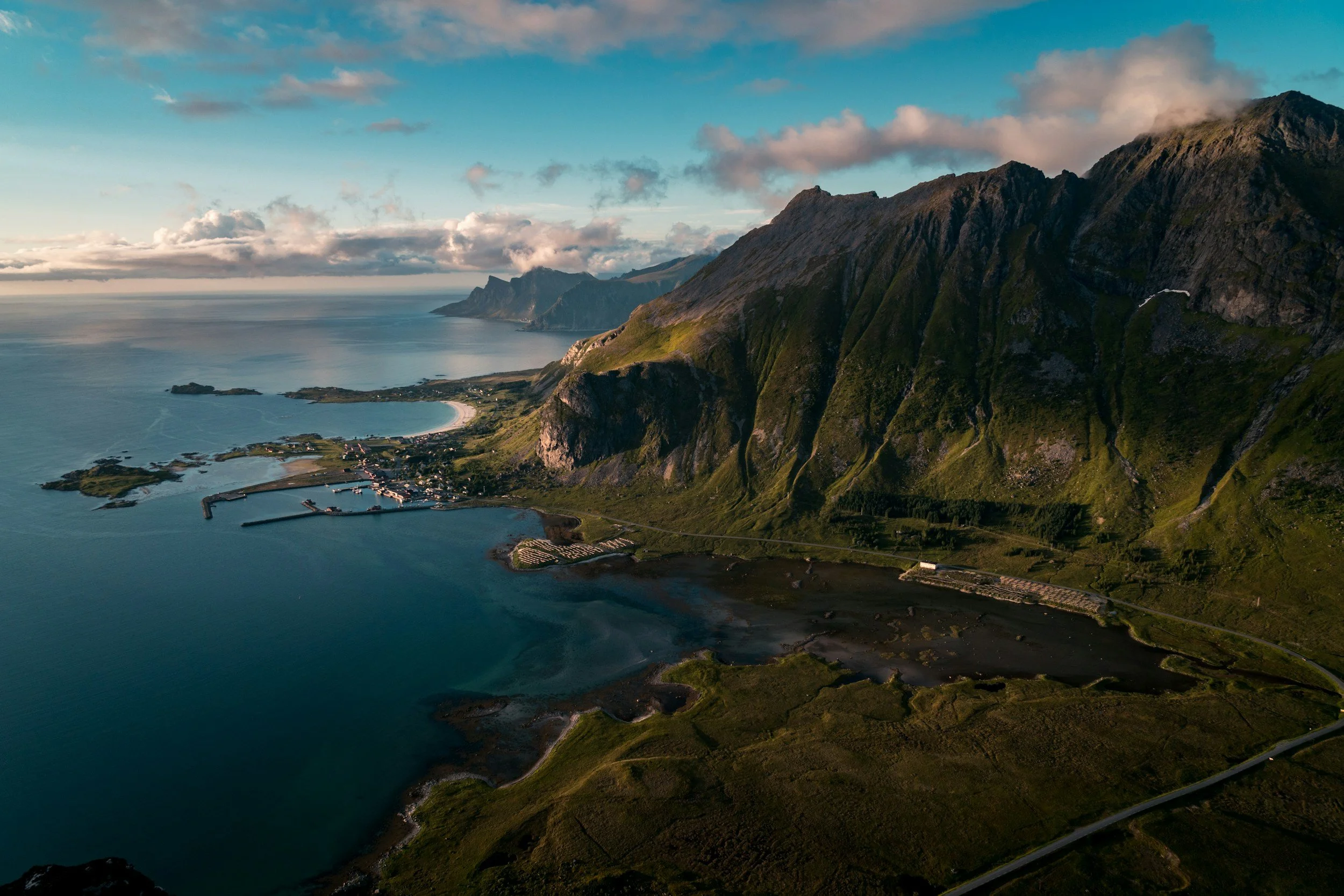
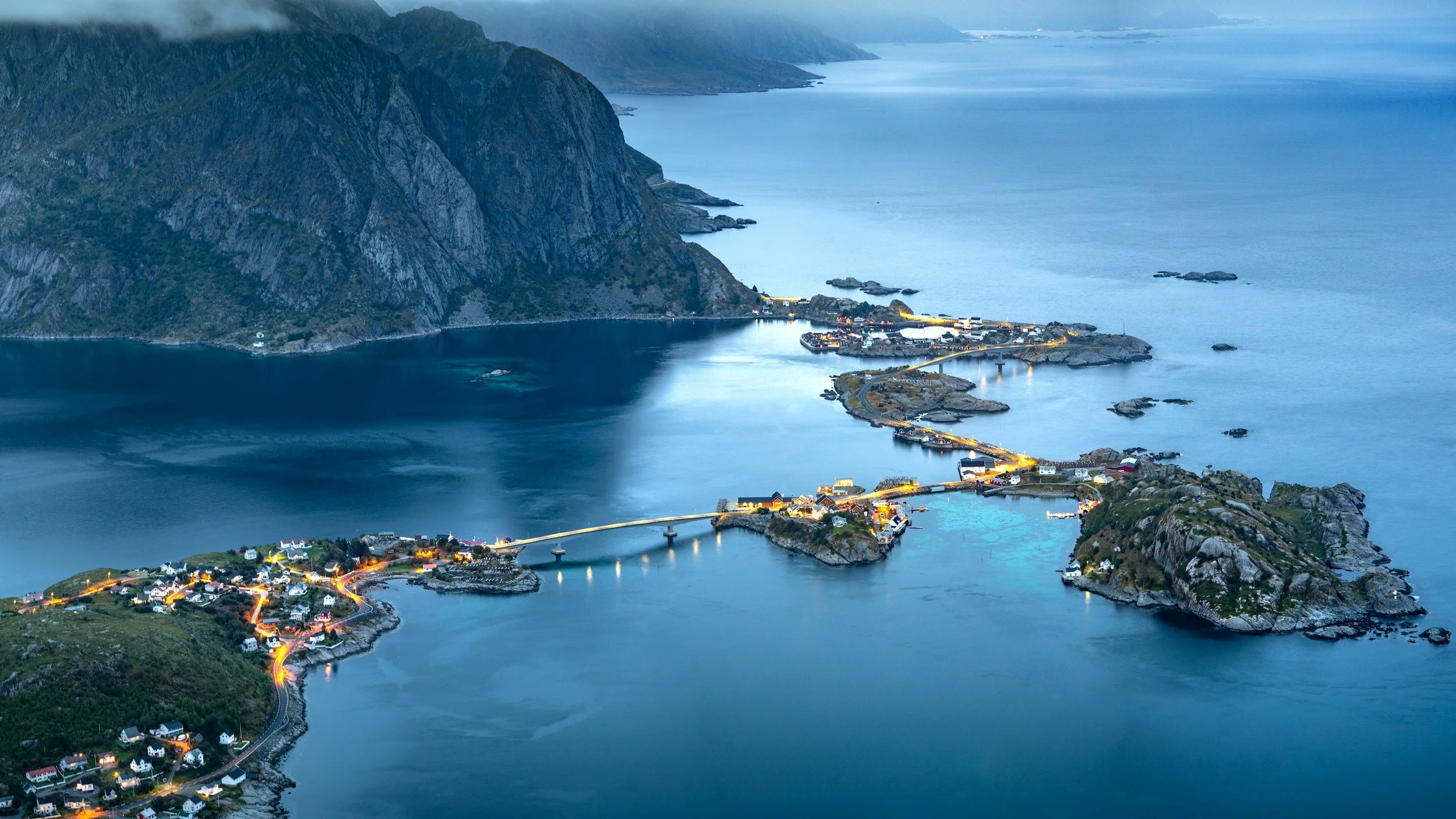
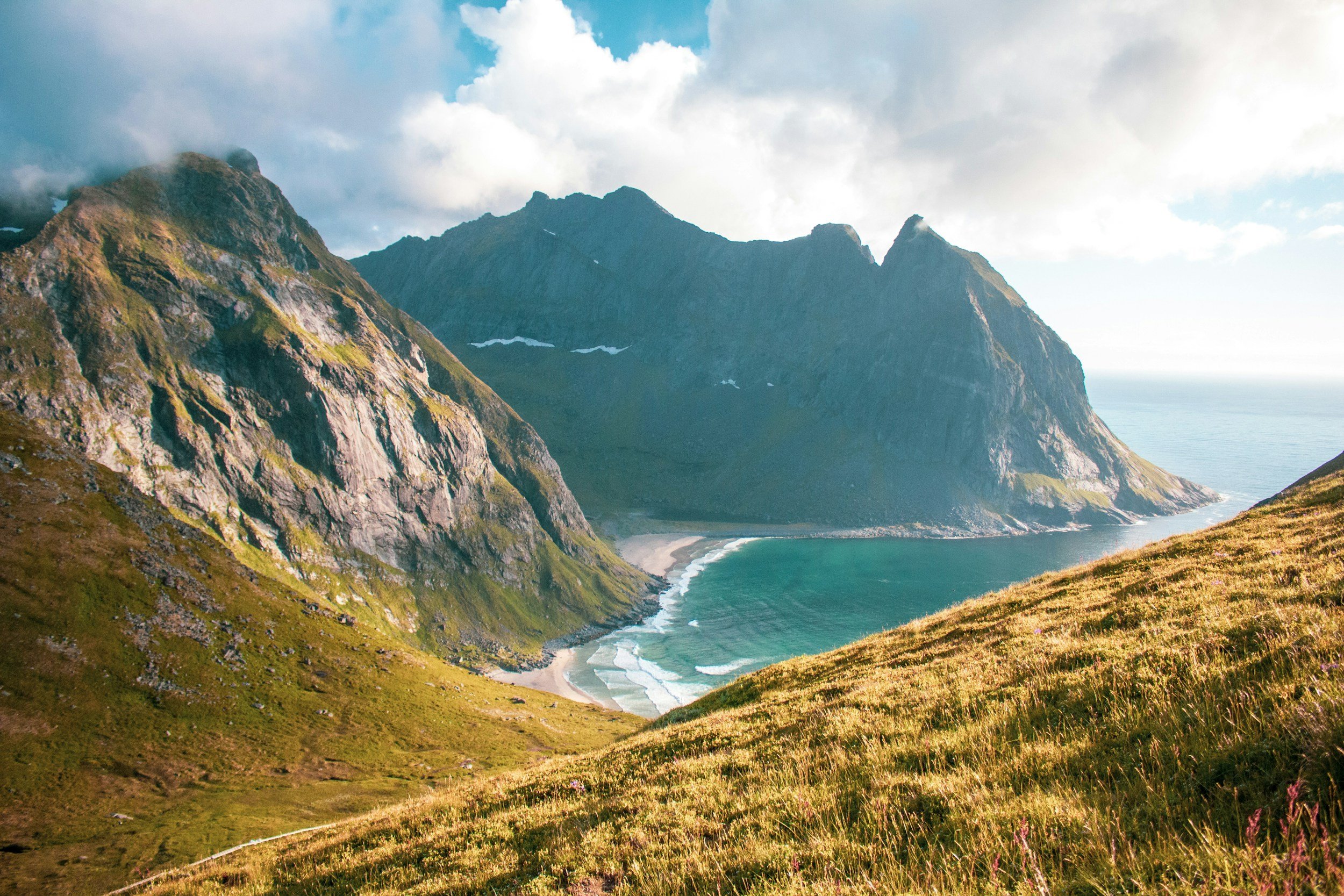
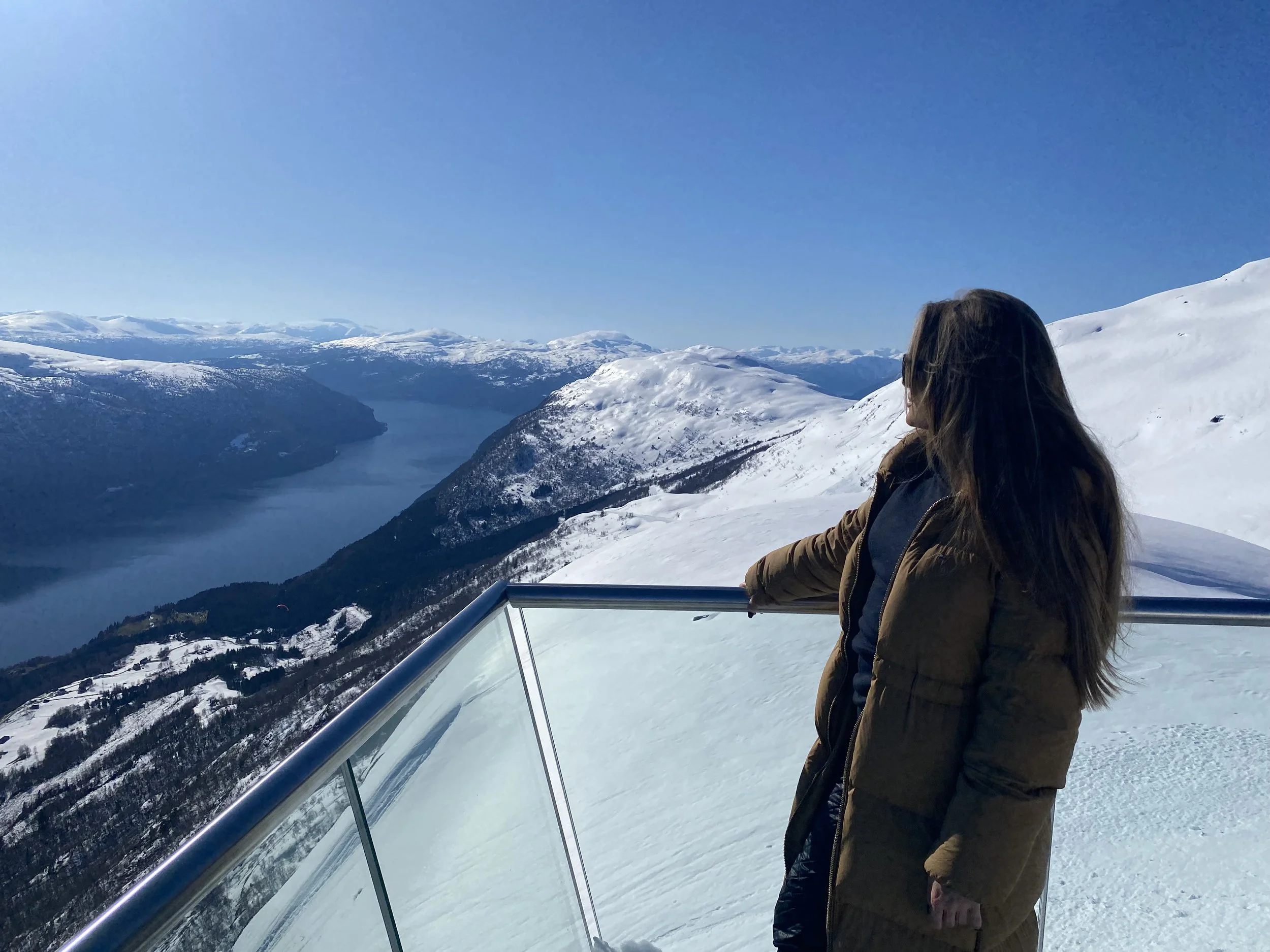
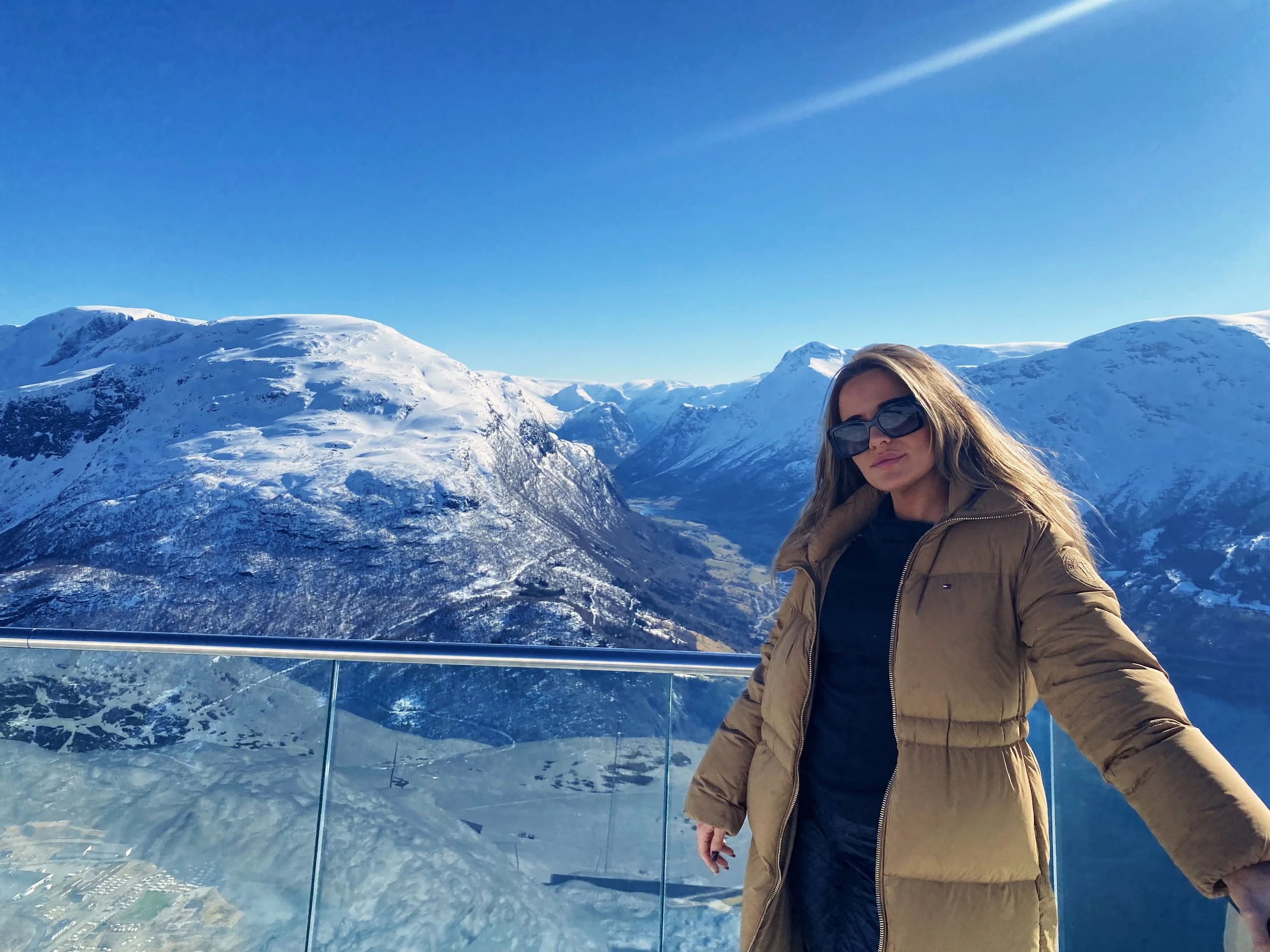
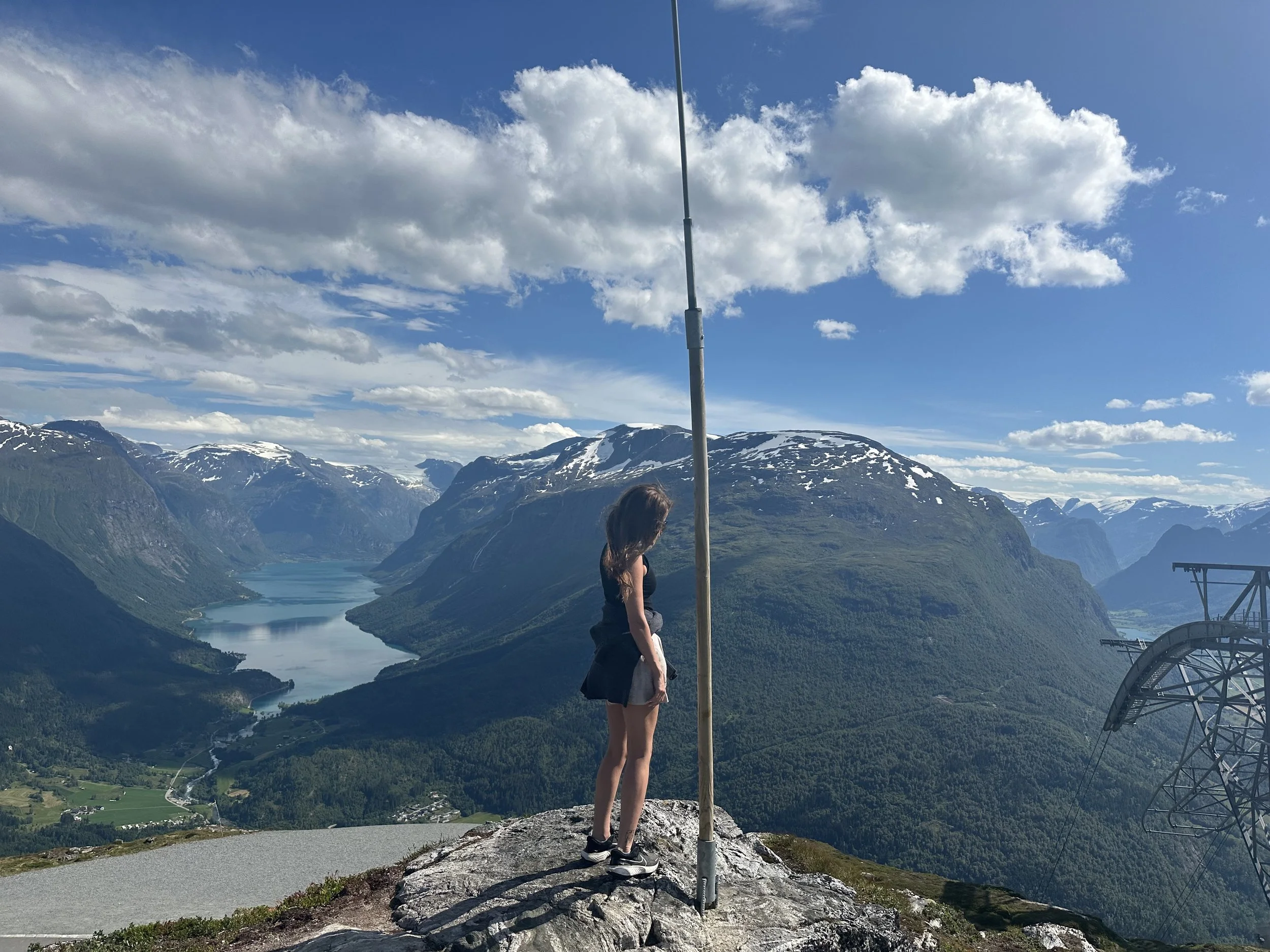
Senja is increasingly described as a quieter alternative to Lofoten. But are the two really comparable? Here is how Senja and Lofoten differ, and which one I would choose for different types of trips.